Chatbot or Voice Bot? How to Choose the Right AI Channel for Your Customers
The short answer: in the chatbot vs voice bot choice, don’t pick a side; pick the job. Text works best when customers need to see something: a link, a form, an order or a document. Voice works best when the moment is urgent or emotional, when hands are busy, or when your customers simply phone you. Most businesses should start where their contacts already arrive, and build one shared “brain” so adding the second channel later is cheap.
Customers no longer wait for office hours. In Zendesk’s CX Trends 2026 research, 74% of consumers said they now expect service around the clock because of AI. The question most founders ask next is whether that service should type or talk. Our Agent Engineering team builds both, and this guide gives you a plain way to decide.
Two words explained
- Chatbot (text AI agent): answers in writing, on your website, app, WhatsApp or SMS.
- Voice bot (voice AI agent): answers phone calls or voice in an app. It turns speech into text, decides what to say, and speaks the reply.
Chatbots and voice bots can now do far more than answer FAQs. A good one checks an order, books a slot, or hands the customer to a person with the full story attached.
Do customers prefer chat or phone support?
Customers prefer chat for simple, routine questions and the phone for urgent or emotional ones, so the right channel depends on the moment. Surveys on “preferred channel” disagree with each other, some putting chat first and others phone; one widely shared summary notes that the result changes with who runs the survey. The pattern behind them is steadier:
- Simple, routine questions (order status, opening hours, a password reset) lean to text. It’s quick and the answer stays on screen.
- Urgent or emotional problems (a failed payment, a medical worry, a blocked card) lean to the phone. People want to explain in their own words and hear a reply.
- Some groups lean to voice by default: older customers, people less comfortable writing, and anyone driving, cooking or working with their hands.
The right question is therefore not “text or voice?” but “which jobs, for which customers, at which moments?”
How do you choose between a chatbot and a voice bot?
Choose between a chatbot and a voice bot by answering five questions about your own contacts:
- Where do contacts arrive today? Count last quarter’s calls, chats, emails and messages. Automate the channel that already carries the volume.
- What are the top ten jobs? List the reasons people contact you. Mark each one “needs to see something” or “needs to talk it through”.
- Who are your customers? Age, language, accents and comfort with technology all shift the answer.
- When do they contact you? If many calls arrive after hours, a voice agent closes a gap your team can’t.
- What must they see, sign or pay? Forms, payments and documents belong on a screen, even if the conversation starts on a call.
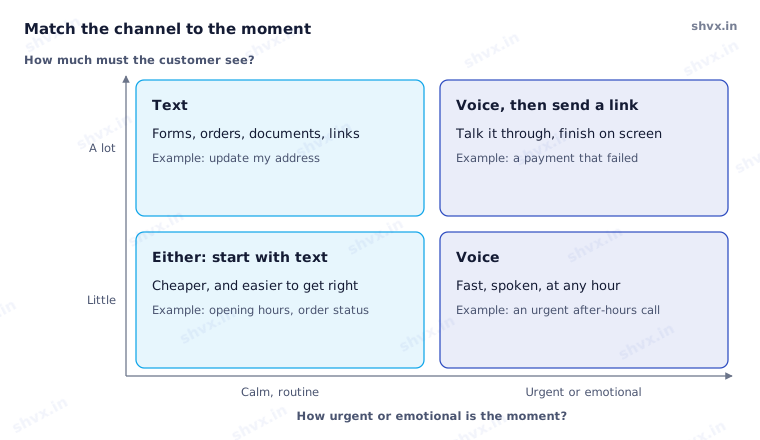
Place each of your top contact reasons on this grid. Jobs on the right want a voice; jobs at the top want a screen; a job in the top-right corner wants both, a call that ends with a link.
How do chatbots and voice bots compare?
| Text AI agent | Voice AI agent | |
|---|---|---|
| Effort to build well | Lower | Higher: speech, timing and phone systems add work |
| Running cost per conversation | Lower | Higher: phone minutes plus speech services |
| Hardest thing to get right | Clear, short answers with the right links | Speed: replies must start in about a second |
| Common errors | Wrong link or out-of-date answer | Misheard names, numbers and accents |
| Best for | Routine questions, anything visual, forms | Urgent issues, after-hours calls, customers who prefer to talk |
| Privacy points | Chat logs | Call recordings and consent rules, which vary by country |
Voice is harder for one simple reason: people forgive a two-second delay on screen, but silence on a phone call feels broken. In LangChain’s survey of agent builders, latency was the second biggest barrier to production, and it bites hardest on voice.
Can one AI agent handle both chat and voice?
The costly mistake is to buy a chatbot from one vendor and a voice bot from another. You end up with two sets of answers, two sets of rules, and customers who get different replies depending on how they ask.
The better design is one agent “brain”: your knowledge, your business rules, the tools that check orders or book appointments, and the rules for handing over to a person. Then put two front doors on it: a chat window and a phone line. The voice door adds speech and telephony on top; everything behind it is shared.
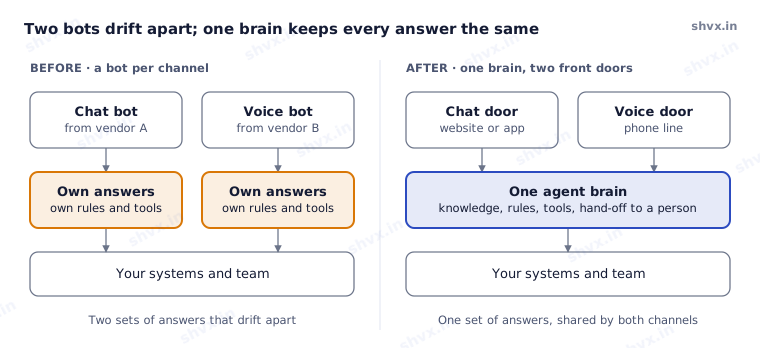
On the left, every change has to be made twice and the two bots slowly disagree. On the right, you fix an answer once and both channels get it, so adding voice later costs a front door, not a second project.
Which channel should you build first?
- Start with the channel that carries most of your volume today, and automate its top three jobs.
- Measure for a month: how many conversations are fully resolved, how many are handed over, and what customers say.
- Add the second door for the moments the first can’t serve, often after-hours calls.
- Let them work together. A voice agent can text a payment link mid-call, and a chat can offer a call-back.
Common mistakes
- Building a voice bot that behaves like an old phone menu (“press 1 for…”).
- No easy way to reach a person, on either channel.
- Reading long written answers aloud. Voice answers must be short.
- Choosing the channel from a trend report instead of your own contact data.
How SHVX can help
If customers are waiting for answers after hours, or your team spends its day on the same ten questions, the fix starts with the right channel. An SHVX assessment reviews your contact data and use cases, and gives you a written recommendation on which channel to build first and what it will take.
Learn more about Agent Engineering.
FAQ
Is a voice bot better than a chatbot?
Neither is better in general. Voice suits urgent and spoken moments; text suits routine and visual ones.
Do customers mind talking to AI?
Many don’t, as long as it solves the problem quickly and lets them reach a person when needed. Always tell callers they are speaking to an AI.
Which is cheaper to run?
Text, usually. Voice adds phone minutes and speech services to every conversation.
Can one AI agent handle both chat and calls?
Yes. Build the knowledge, rules and tools once, and connect both channels to it.