How to Choose an Open-Weight Coding Model for Your Team
open-weight coding models can run on your own servers, keeping code in-house and costs fixed. The best one for your team is not the top of a leaderboard; it’s the one that does well on your own code, has a licence you can accept and costs less than the alternative at your volume.
The short answer: pick an open-weight coding model in five steps: shortlist two or three candidates that fit your hardware, test them on real tasks from your own repository, read each licence, check where the weights come from and where the model will run, and compare the full running cost with per-token API pricing. Then run a security review and a two-week pilot with a few developers before rolling out.
Engineering leaders are asking whether a self-hosted coding LLM, built on an open-weight model, can replace or sit beside commercial coding assistants. Our earlier guide, Commercial vs Open-Source LLMs, covers hosting options in general. This post is the coding-specific method. It sits in our Agent Engineering work.
Why not just pick the leaderboard winner?
Public coding benchmarks test public code in popular languages. Your codebase has its own frameworks, conventions, older languages and internal libraries. A model that tops a leaderboard can still struggle with your stack, and a smaller one can do better on it. Benchmarks are a way to shortlist, not to decide.
Step 1: Shortlist by hardware and job
Decide where the model will run before you compare models:
- A developer’s workstation GPU: smaller models suited to autocomplete and single-file edits.
- One server-class GPU: mid-size models that can handle agentic, multi-file work.
- A multi-GPU server or cluster: the largest open models, closest to commercial quality, at the highest running cost.
Then pick two or three candidates that fit.
Step 2: Test on your own repository
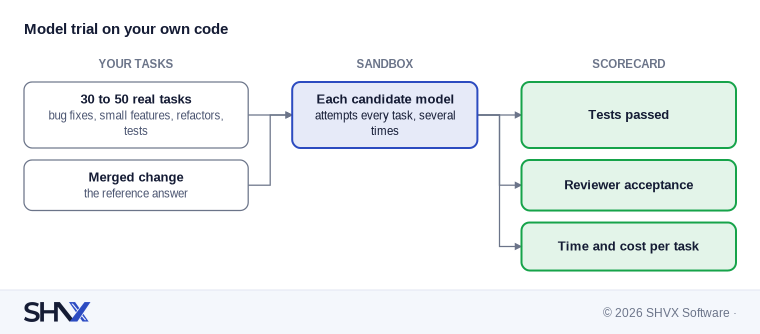
Take 30 to 50 real tasks from your own history: bug fixes, small features, refactors, test writing, each with the change your team actually merged. Run each candidate on every task several times in a sandbox, and score:
- tests passed by the model’s change;
- reviewer acceptance: would a senior developer merge it with little or no editing?
- time and cost per task.
Run the same tasks through the commercial assistant you use today as a baseline. Our guide to testing AI agents explains repeat runs and pass rates.
Step 3: Read the licence
“Open-weight” means you can download and run the model; it doesn’t mean no conditions. Many coding models use permissive licences such as Apache 2.0 or MIT. Others use custom licences with limits on use, user numbers or attribution; one recent flagship, for example, allows in-house use but needs a separate licence to resell it as a hosted service. Read the actual licence on the model card, and have legal review it before commercial use.
Step 4: Check where the model comes from and where it runs
- Source: download weights only from the publisher’s official repository and verify checksums.
- Where it runs: your own servers, a private cloud account or a managed open-weight service, which affects both data residency and effort.
- Your policies: some organisations have rules about models from particular publishers or countries. Check them before testing, not after.
Step 5: Compare the full running cost
Use the same cost check as our hosting guide: monthly server cost plus the people who run it, divided by the work it does. Compare that with your current per-token or per-seat spend, using real usage numbers. Our guide to reducing Claude Code costs shows how to measure what your team actually uses. Self-hosting wins when GPUs stay busy; idle GPUs are the most expensive option.
Example open-weight coding models (November 2026)
These are examples from public sources to start a shortlist, not recommendations or models SHVX has used. Versions change monthly; check the model card for current licence and sizes.
| Model family | Licence (per model card) | Typical place to run |
|---|---|---|
| Qwen3-Coder line (Alibaba Qwen) | Apache 2.0 for listed models | Workstation to multi-GPU, by size |
| Devstral Small 2 (Mistral AI) | Apache 2.0 | One 16–24 GB GPU |
| gpt-oss (OpenAI) | Apache 2.0 | Workstation or one server GPU |
| DeepSeek V4 Flash (DeepSeek) | MIT | Multi-GPU server |
| Mistral Large 4 (Mistral AI) | Mistral Ecosystem Open-Weight License (modified MIT; selling it as a hosted service needs a separate licence) | Rack-scale servers |
Sources: vdf.ai coding model comparison, November 2026 and Danube Labs, October 2026. Refreshed quarterly. At each refresh, link each row to the publisher’s own model card rather than a comparison site.
How do you roll it out safely?
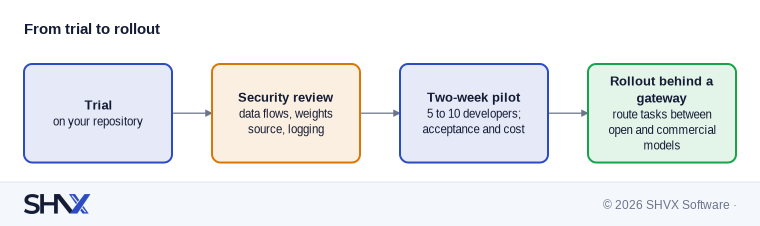
Put a gateway between developers’ tools and the models, so easy tasks go to the open model and hard ones to a commercial model when needed. Pin the model version, keep your task set as a regression test, and re-run it before every upgrade, as described in DevOps for AI agents.
Common mistakes
- Choosing from a leaderboard instead of your own code.
- Skipping the licence because the model is “open”.
- Comparing GPU prices with token prices without counting people and idle time.
- Downloading weights from unofficial mirrors.
- Replacing the commercial assistant everywhere at once.
Model examples checked against public sources in November 2026.
How SHVX can help
Considering an open-weight coding model? We’ll trial two or three models on tasks from your own repository and give you a written recommendation with the licence notes and the cost comparison.
Learn more about Agent Engineering.
FAQ
What is the best open-source LLM for coding?
The one that scores best on your own repository tasks, under a licence you accept and at a cost below your current tools. Shortlist from public benchmarks, then test.
Can open-weight models replace commercial coding assistants?
For many routine tasks, increasingly yes. Many teams keep a commercial model for the hardest work and route the rest to an open model.
Are open-weight coding models free for commercial use?
Many use Apache 2.0 or MIT licences with few conditions; others have custom terms. Always read the licence on the model card.
How do I test a coding model on my own codebase?
Take 30 to 50 real tasks from your repository history, run each model several times in a sandbox, and score tests passed, reviewer acceptance, time and cost.