What Does It Cost to Run an AI Agent in the Cloud? The Monthly Bill, Line by Line
The short answer: an AI agent’s monthly bill has seven lines. Most of them grow with use: model tokens, tool calls, search and logs. A few cost money every hour whether anyone uses the agent or not: networking, security and test environments. Model tokens usually drive the bill, and they depend on how many steps the agent takes and how much it reads at each step, not just on how many customers it serves.
Running cost is where many agent projects quietly die. Gartner expects over 40% of agentic AI projects to be cancelled by the end of 2027, and escalating cost is one of the three reasons it gives. Founders and leaders should know an agent’s monthly running cost before they commit. Our Agent Operations team builds these budgets for clients with the method below.
Three words explained
- Token: a small chunk of text, about three-quarters of a word. AI models charge per million tokens they read (input) and write (output).
- Agent step: one round of the agent thinking and acting, such as “search the policy” or “check the order”. Each step is usually a separate, paid model call.
- Always-on cost: a charge for every hour a service exists, even with no traffic.
Why does an AI agent cost more than a chatbot?
A simple chatbot makes one model call per question. An agent plans, calls a tool, reads the result, and decides again, often several model calls for one customer request. Each call also re-reads the instructions, the conversation so far and any documents it fetched, so the text it reads grows with every step. Agent design, not just customer numbers, therefore decides the bill: the same 10,000 customers can cost very different amounts.
What is on an AI agent’s monthly cloud bill?
An AI agent’s monthly cloud bill has seven lines: model tokens, agent runtime, tool and API calls, search and knowledge, logs and tests, networking and security, and test environments.
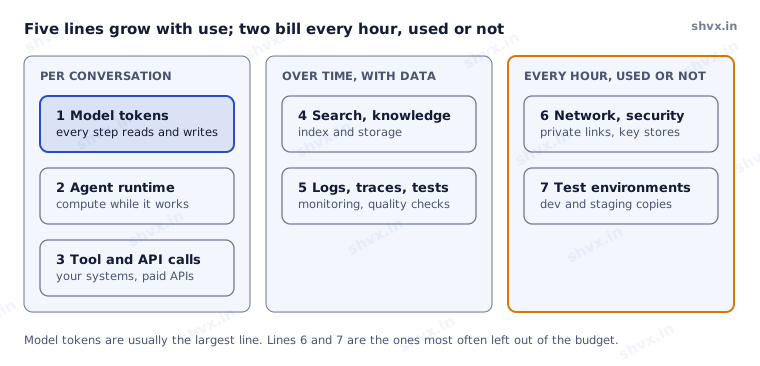
The left and middle groups rise and fall with traffic, so a quiet month costs less. The right group bills every hour the agent exists, which is why test environments left running are the classic surprise.
| Line | What it pays for | How to keep it down |
|---|---|---|
| 1. Model tokens | The AI model reading and writing at every step | Send easy steps to small models, cache repeated text, keep context short |
| 2. Agent runtime | The compute where the agent’s code runs | Use services that bill only for active time |
| 3. Tool and API calls | Calls to your systems and paid outside APIs | Fewer steps per task, cache repeat lookups |
| 4. Search and knowledge | The search index and its storage | Index only what the agent needs, archive the rest |
| 5. Logs, traces and tests | Monitoring and regular quality checks | Sample routine traffic, set how long logs are kept |
| 6. Networking and security | Private network links, firewalls, key stores | Share them across agents rather than one set each |
| 7. Test environments | Development and staging copies of the agent | Switch them off at night and at weekends |
Line 6 is the one that surprises people. For example, at AWS’s US East rates a NAT gateway, a common piece of a private network, bills $0.045 an hour, about $33 a month, before it carries a single byte. Small on its own, but these add up across environments and regions.
How is AI model cost calculated?
AI model cost is four numbers multiplied together. Change any one and the bill moves.
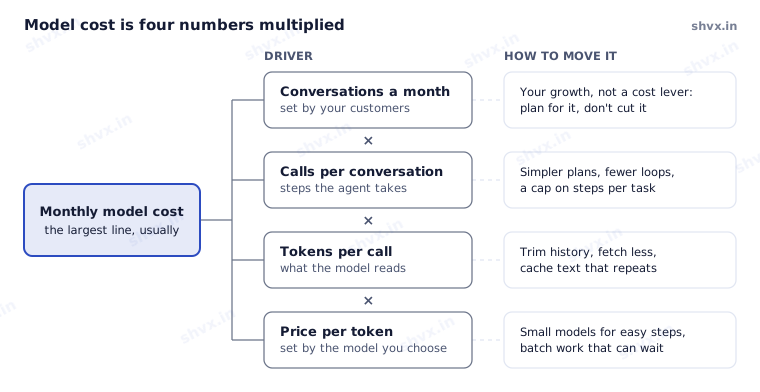
The first driver is growth you want. The other three are design choices, and each one can cut the bill sharply without serving a single customer less.
The worked example below uses round, example prices, not a quote. Check your provider’s price page for real figures.
- 20,000 conversations a month
- 6 model calls per conversation
- 8,000 tokens read per call (instructions, history and fetched documents) and 400 written
- An example price of $3 per million tokens read and $15 per million written
| Scenario | Monthly model cost | Per conversation |
|---|---|---|
| Every step on a strong model | $3,600 | $0.18 |
| Four easy steps moved to a small model at one-tenth the price | $1,440 | $0.07 |
The working: 20,000 × 6 × 8,000 = 960 million tokens read, or $2,880, plus 48 million written, or $720. Moving the four simple steps (sorting the request, checking a format, summarising) to a cheaper model cuts the bill by 60% with no change in traffic. Caching the repeated instructions, which most providers price far lower, cuts it further.
Why does an AI agent cost more in production than in a pilot?
A pilot is cheap because it runs in one environment, with a few users, and nobody is on call. Production adds a second copy for uptime, staging and test environments, private networking, longer log retention, regular quality checks and people to run it. Budget for these from day one; they are why a cheap pilot can become a much larger monthly bill.
If you are weighing self-hosted models against paying per token, the cost-per-million-tokens check in Commercial vs Open-Source LLMs applies here too.
How do you prevent AI agent bill shock?
Five guardrails prevent AI agent bill shock:
- Set a cost-per-task target before you build, such as “under 10 cents per resolved request”, and test against it.
- Cap steps and spend per task in the model gateway, so a confused agent can’t loop all night.
- Alert on cost per task, not just the total. A sudden jump is often the first sign of a bug or a model change.
- Tag every resource by agent and environment, so you know which agent spends what.
- Review monthly and move steady work to cheaper models or reserved capacity.
Common mistakes
- Budgeting from a demo that took one step per question.
- Forgetting always-on charges in test environments.
- Running every step on the most powerful model.
- No per-task cost alert until the invoice arrives.
How SHVX can help
If you can’t say what one resolved request will cost you, you can’t say whether the agent pays for itself. Our Agent Operations team models your monthly bill line by line, sets the caps and alerts, and reviews spend with you after launch.
Learn more about Agent Operations.
FAQ
How much does it cost to run an AI agent per month?
It depends mostly on conversations per month, steps per conversation and the model used. Work it out as conversations × calls × tokens × price, then add the fixed lines.
What is the biggest cost of an AI agent?
Usually model tokens. Always-on networking and test environments are the most commonly forgotten.
How can I reduce AI agent costs?
Route easy steps to small models, cache repeated text, cap steps per task and switch off idle environments.
Is building the agent or running it more expensive?
Over a few years, running it usually costs more, because the bill repeats every month.
Prices checked against public AWS pricing commentary in November 2026. Cloud prices change often; re-check before you budget.