Why Customers Drop Off in Onboarding and Payment, and How AI Journey Analytics Finds the Cause
AI tools can now watch every customer journey on your website and tell you in plain words where people give up. But many sign-up and payment failures happen out of sight, in a bank, an OTP service or an ID check. You only see the full picture when the website data and your back-end data are joined.
The short answer: AI changed journey analytics in three ways. Capture is easier, because one script records every click without tagging each button. Analysis is faster, because AI agents summarise thousands of session replays and flag the step where people struggle. Access is wider, because anyone can ask questions in plain English. What AI can’t fix is missing data: for onboarding and payments, send back-end events (payment declined, ID check failed) into the same view, under the same customer ID.
Every founder knows the feeling: marketing brings people in, and the numbers say most of them never finish signing up or paying. The usual tools show where they leave. AI-enabled journey analytics can now show why, provided the data underneath is set up so the AI has something true to work with. It sits in our Agent-Ready Data practice, because it is a data problem before it is an AI problem.
Six words explained
- Event: one recorded action, such as “sign-up started” or “payment declined”.
- Funnel: the steps a customer must pass in order, and how many make it through each one.
- Session replay: a video-like reconstruction of a visit, built from clicks and page changes, not a camera.
- Autocapture: a script that records every click and page view automatically, so you can define funnel steps later.
- Server-side event: an event sent from your own systems, not the browser, such as the payment gateway’s final answer.
- Consent: the customer’s permission to be tracked, which many privacy laws require before you record anything.
How has AI changed customer journey analytics?
AI has made customer journey analytics faster to set up, faster to analyse and open to anyone who can ask a question in plain English.
Before: a developer tagged every button through a tag manager, an analyst built funnels by hand, and someone watched replays one by one. Insights arrived in a monthly report, long after the problem started.
Now: autocapture records everything from day one. AI agents monitor funnels and alert you when a step drops. AI agents also watch replays at scale and summarise what went wrong. Amplitude’s Session Replay Agent, for example, became generally available on all plans in June 2026 and analyses replays across funnels on a schedule. Several platforms now also offer MCP connections, so your own AI assistant can query journey data directly.
How do you find the real cause of a drop-off?
To find the real cause of a drop-off, join what customers do on screen with what your systems record, under one customer ID.
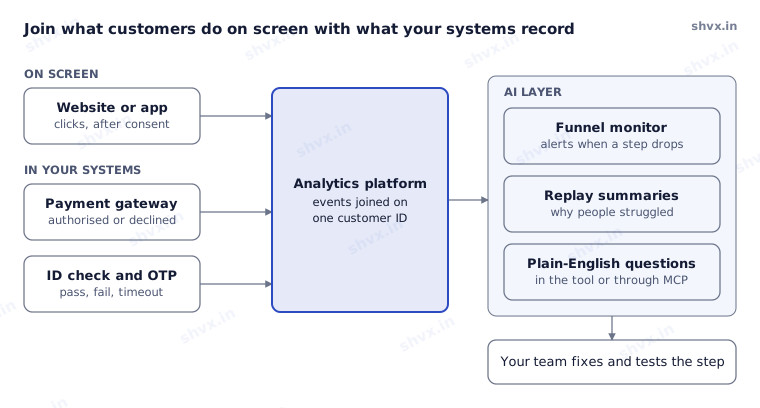
The top source shows what people do; the two below show what happened to them. Only when all three share one customer ID can the AI layer explain a drop instead of just reporting it.
Why can’t session replay explain payment drop-off?
Session replay only sees the browser, and many payment and onboarding failures happen in back-end systems the browser can’t see. A customer who abandons a pricing page left because of something on the screen. A customer who drops out of payment or identity checks often didn’t choose to leave at all.
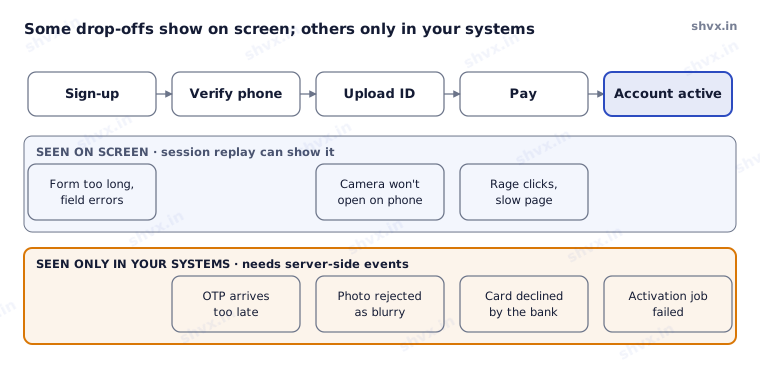
Each cause sits under the step where it strikes. The top lane is what replay tools already catch; the highlighted bottom lane is invisible to them until your own systems report it.
The browser sees the spinner, then the exit. It can’t see that the bank declined the card, the OTP message arrived late, or the ID photo was rejected as blurry. The answers to those failures live in your payment gateway, SMS provider and verification service. Send them in as server-side events, and the AI can tell you not just that people are leaving at payment, but that most of them were declined by one issuing bank.
How do you set up tracking for onboarding and payment?
A tracking plan for onboarding and payment takes six steps:
- Write the funnel down. List the real steps, from landing to active account, and name the one number that matters, such as payment success rate.
- Name events one way. Use a simple pattern such as
payment_declinedordocument_uploaded, written in a shared tracking plan. - Send outcomes from the server. Payment results, ID check results and account activation come from your systems, not the browser, because browser events get blocked or lost.
- Use one customer ID everywhere. The same ID on the website and in every back-end event is what lets the two be joined.
- Ask consent and mask by default. Never record card numbers, ID numbers, passwords or one-time codes in replays. Mask every input field unless you have a reason not to.
- Test the data before trusting it. Compare a week of tracked payments with your payment gateway’s own report. If they differ, fix the tracking first.
Which customer journey analytics tools should you use?
We recommend Amplitude, Contentsquare and Microsoft Clarity. All three add AI on top of funnels and session replay, and they differ in depth, price and who they suit.
| Tool | Best for | AI features | Watch out for |
|---|---|---|---|
| Amplitude | Product teams that want funnels, replay and experiments in one place | AI agents that monitor dashboards and analyse replays across funnels; plain-language questions; MCP access | Needs a disciplined tracking plan; cost grows with event volume |
| Contentsquare | Larger consumer and financial websites with many journeys | Sense AI agent, journey analysis, frustration scoring, replay summaries; now includes Hotjar | Enterprise pricing and set-up effort |
| Microsoft Clarity | Starting today at no cost | Copilot summaries of recordings and heatmaps, funnels, rage-click detection | Lighter on deep funnel and cohort analysis; check its data terms for regulated flows |
How to choose: if you have nothing today, install Clarity this week to see real behaviour. Move to Amplitude when product teams need funnels, experiments and AI monitoring together, or to Contentsquare when many web journeys and teams need one enterprise view. If data must stay in your own environment, look at open-source options you can host yourself, such as PostHog.
What should you measure in onboarding and payment?
- Step conversion: the share of people who pass each funnel step.
- Payment success rate: authorised payments divided by payments started, split by method and bank.
- Time to active: how long from sign-up started to account ready.
- ID check first-pass rate: the share of documents accepted the first time.
Common mistakes
- Recording payment or ID fields in session replay.
- Counting “purchase complete” from the browser instead of the payment gateway.
- Tracking hundreds of events nobody uses, and missing the five that matter.
- Acting on an AI summary without watching a few of the replays it is based on.
How SHVX can help
If your funnel shows people leaving at payment or onboarding and nobody can say why, the missing piece is usually the data, not the tool. Our Agent-Ready Data team designs the tracking plan, connects your back-end events and sets up the AI analysis, so you can see the cause, not just the drop.
Learn more about Agent-Ready Data.
FAQ
What is a customer journey analytics tool?
Software that records how people move through your website or app and shows where they succeed, struggle or leave.
How does AI help with checkout drop-off?
It watches funnels for sudden drops, summarises the session replays behind them and points to the step and the likely cause.
Is session replay legal?
Usually, with the right consent and masking of personal fields. Rules differ by country, so check with your legal team.
Why don’t my analytics match my payment provider’s numbers?
Browser events get blocked or lost. Send payment results from your server and treat the payment provider as the source of truth.
Tool features checked against vendor pages in November 2026. These products change fast; re-check before you publish.