AI Loan Processing: Faster, Bank-Ready Loan Proposals
The short answer: an AI pipeline can read a borrower’s whole document pile, pull out the figures a bank needs, check that they agree with each other, and draft the proposal in each bank’s format, with every number linked to the page it came from. Your credit analyst reviews and signs off. The result is faster proposals and fewer rounds of bank queries, because the numbers are consistent and easy to verify.
Lending firms and loan advisors sit between borrowers and banks. They collect the documents, make sense of them, and present a proposal the bank can approve. Most of that work is reading, retyping and reconciling figures by hand. This guide explains what AI can take over and what must stay with your team. It sits in our Agent-Ready Data work, because in lending the hard part is getting the borrower’s data right.
What’s in a typical loan file?
A business or property loan file usually holds:
- Financial statements: profit and loss, balance sheet and notes, often for three years, audited or not.
- Bank statements: six to twenty-four months, from several banks, as PDFs or scans.
- Tax returns and tax computations.
- Property papers: title documents, valuation reports, approved plans, for secured loans.
- Identity and business documents: registrations, ownership details, existing loan sanctions and repayment schedules.
These arrive over days or weeks, in mixed quality, often by email and messaging apps. Many run to hundreds of pages.
Where does the time go?
- Sorting and chasing. Working out what has arrived, what is missing and which version is current.
- Spreading the financials. Typing figures from statements into the bank’s credit template, year by year, line by line.
- Analysing bank statements. Working out real monthly inflows, existing loan repayments and bounced cheques, often by hand in a spreadsheet.
- Checking consistency. Does turnover in the accounts match the money flowing through the bank and the income in the tax return?
- Answering bank queries. Each inconsistency the bank spots becomes a query, and each query adds days.
That last point is the real cost. A proposal with figures that don’t agree, or can’t be traced to a document, goes back and forth until the borrower loses patience or the bank loses interest.
What the AI pipeline does
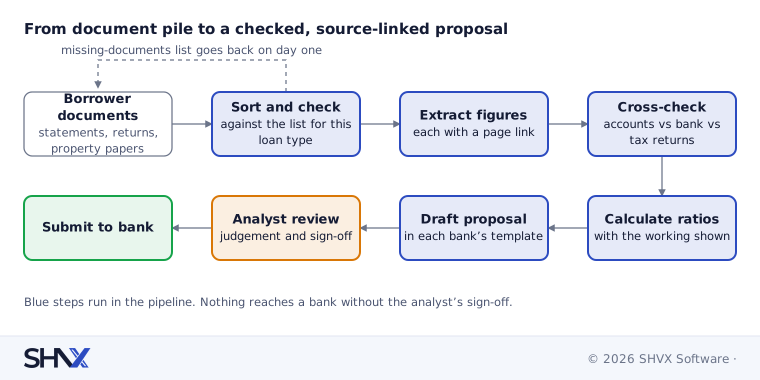
- Sort and check completeness. Each document is classified (statement, return, valuation report) and checked against the list for that loan type. A missing-documents list goes back to the borrower on day one, not week two.
- Extract the figures. Revenue, profit, debts, assets, monthly bank inflows and existing loan repayments are pulled out, each with a link to its page.
- Cross-check. Turnover in the accounts is compared with bank credits and declared income. Large gaps, round-number transfers between related accounts and unexplained jumps are flagged with the evidence.
- Calculate. The ratios banks ask for, such as how comfortably the business can cover its loan repayments from its income, are computed from the extracted figures, with the working shown.
- Draft. The proposal is filled into each bank’s own template, since every bank asks for things slightly differently.
- Review and sign off. Your analyst checks the flags, adds judgement about the borrower, and signs. Nothing goes to a bank without a person’s approval.
The bank statement step is the most technical. Our companion post, Bank Statement Analysis with AI, explains how it works.
Why consistent, source-linked figures mean fewer bank queries
Bank credit teams look for two things: numbers that agree with each other, and numbers they can verify quickly. When every figure in your proposal links back to the page it came from, and the cross-checks have already explained the differences, the bank’s analyst spends less time asking and more time deciding.
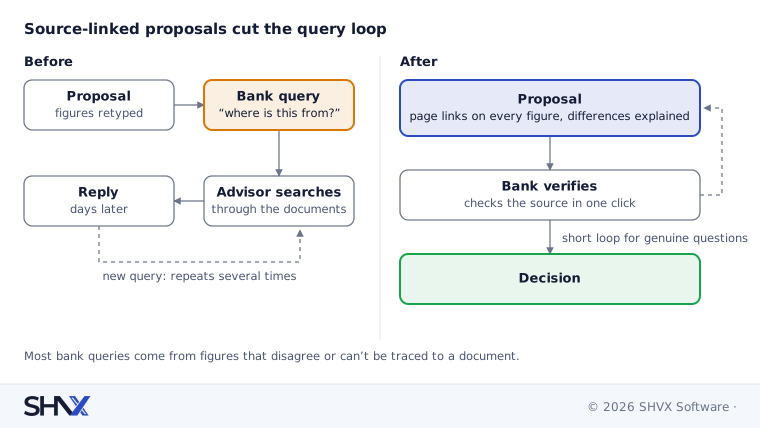
It also protects your firm. If a figure is challenged later, you can show exactly where it came from and who approved it.
What stays with your team
- Judgement about the borrower: the business model, the promoters, the story behind the numbers.
- Choosing the bank and the product.
- Explaining unusual items the pipeline has flagged.
- Signing off every proposal. The pipeline prepares; people decide.
Borrower data is sensitive. The pipeline should run in an environment you control, use only approved models, and never use borrower data to train a model.
How to start
Take ten past loan files where you know the final approved figures. Run them through the pipeline and compare its output, field by field, with what your analysts produced. If the figures match and the flags are useful, run new files in parallel for a few weeks, then switch.
We use the same approach for insurance documents: messy files in, verified, source-linked records out, with people reviewing only what the system is unsure about.
Common mistakes
- Automating the proposal template before the extraction is accurate.
- Skipping the cross-checks, which are what reduce bank queries.
- Testing on clean files instead of real, messy ones.
- Sending borrower documents to tools with unclear data terms.
How SHVX can help
Spending days on each loan proposal? Send one anonymised loan file. We’ll show you the draft proposal data our pipeline produces, with every figure linked to its source.
Learn more about Agent-Ready Data.
FAQ
Can AI approve loans?
In this setup, no. It prepares and checks the proposal. Your analysts and the bank make the decisions.
Does it work with every bank’s format?
Each bank’s template is set up once. After that, the same extracted data fills all of them.
What about scanned or poor-quality documents?
They are cleaned and read with OCR, and low-confidence figures go to a person for review.
Is borrower data safe?
It should stay in an environment you control, with approved models only and no training on your data. Ask any provider to confirm this in writing.