AI Resume Screening: Faster Shortlists, Fairer Hiring
The short answer: use AI to prepare the evidence, not to make the decision. The agent turns each job description into a clear mix of required skills, reads every resume in full, and shows where each skill is proven, with the exact line quoted. Details that invite bias are masked before scoring. Recruiters review the evidence and decide. Done this way, screening is faster and easier to defend, which matters because recruitment AI now faces extra legal scrutiny.
Recruiters and HR heads face hundreds of applications per role, most read for less than a minute. Strong candidates get missed because their best experience sits on page two, or because they describe a skill in different words. This guide explains how AI screening should work if you want both speed and fairness. It sits in our Agent Engineering work.
Why keyword screening fails
Most applicant tracking systems still filter on keywords. That creates two problems:
- Good candidates fall out. Someone who “built dashboards in Power BI for the finance team” may never match a filter for “financial reporting”.
- Keyword stuffers get in. Candidates who paste the job description into their resume rise to the top.
AI language models read meaning, not just words. That fixes much of the matching problem, but it creates a new one: a model can also pick up signals it shouldn’t, such as names, ages or schools that stand in for background. Good design handles both.
How it works: evidence, not scores alone
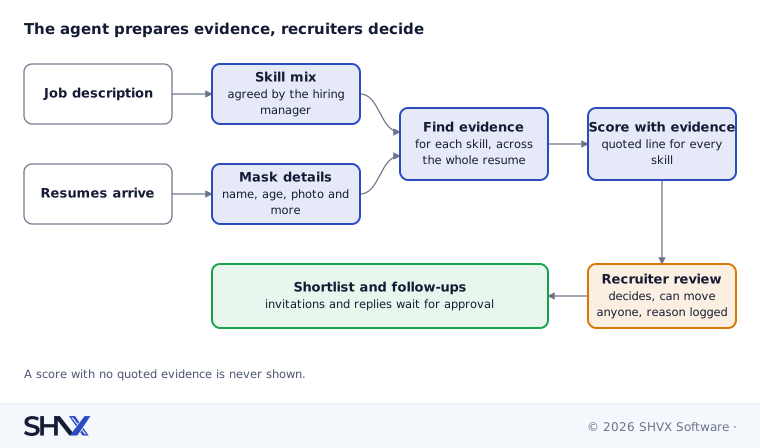
1. Turn the job description into a skill mix. The agent splits the description into must-have and nice-to-have skills, experience levels and certifications. The hiring manager confirms or edits the list before any resume is scored. This step alone often improves hiring, because vague job descriptions become explicit.
2. Find evidence across the whole resume. For each skill, the agent searches the full resume, including project descriptions and earlier roles, and quotes the line that proves it. “Has led teams” becomes “Led a team of six analysts for two years (Role 2, line 4)”.
3. Score with reasons. Each candidate gets a score per skill and an overall fit, always with the evidence attached. A score with no evidence is not shown.
4. Recruiters decide. The recruiter sees the shortlist, the evidence and the gaps, and makes the call. They can move anyone up or down, and their reasons are recorded.
Why does recruitment AI face extra legal scrutiny?
Hiring decisions shape people’s lives, so regulators treat AI used in hiring as high-risk:
- EU AI Act. AI used to filter applications and evaluate candidates is listed as high-risk in Annex III of the AI Act. After the 2026 Digital Omnibus amendment, the main high-risk obligations for these systems apply from 2 December 2027 (National Law Review). They include risk management, human oversight, documentation and logging.
- New York City Local Law 144. Employers using automated employment decision tools must have them bias-audited within a year of use, publish a summary of the results and notify candidates (NYC Department of Consumer and Worker Protection).
- Data protection laws such as GDPR and India’s DPDPA also apply to candidate data: what you collect, why, how long you keep it, and how candidates can ask about it.
Other countries and states are adding similar rules. The safest design is one you could explain to a regulator today: humans decide, every score has evidence, bias is tested, and every step is logged. This is not legal advice; check your obligations with counsel for each country you hire in.
Masking protected details
Before scoring, mask the details that should not influence a shortlist and that often stand in for protected characteristics:
- name, photo, gender and pronouns;
- date of birth, age and graduation years;
- address and nationality, unless the role legally requires them;
- marital status, religion and similar personal details.
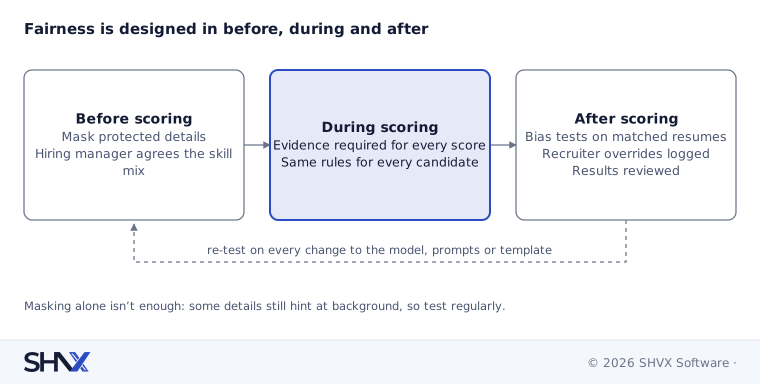
The recruiter can see the full resume once the shortlist is made. Masking alone is not enough, though: some signals, such as certain clubs or schools, can still hint at background. That is why the system must also be tested for bias.
Bias testing, in plain words
Keep a test set of resumes with the same skills but different names, genders, ages and backgrounds. Run them through the screening and check that the scores don’t shift. Repeat every time you change the model, the prompts or the job description template. Our post How to Test AI Agents explains how to make this automatic. The technical detail is in our companion post, How to Match Resumes to Job Descriptions with LLMs.
Follow-up actions, with approval
Once the recruiter has a shortlist, the agent can draft interview invitations, scheduling messages and polite rejections, and update the applicant tracking system. Every message waits for the recruiter’s approval before it is sent. Nothing goes to a candidate automatically.
Common mistakes
- Letting the AI reject candidates without a person reviewing.
- Showing scores without evidence.
- Skipping the hiring manager’s sign-off on the skill mix.
- Never testing for bias, or testing only once.
- Sending candidate data to tools with unclear data terms.
How SHVX can help
Too many applications and too little time to read them properly? Send one job description and a handful of anonymised resumes. We’ll show you the shortlist and the evidence behind every score.
Learn more about Agent Engineering.
FAQ
Is AI resume screening legal?
Generally yes, with conditions. Many places require human oversight, bias testing, notices to candidates or audits. Check the rules where you hire.
Will the AI reject candidates on its own?
It shouldn’t. In this design it prepares evidence and a ranked list; recruiters decide.
How do you stop it being biased?
Mask protected details, require evidence for every score, test regularly with matched resumes, and log every recruiter override.
Does it work with our applicant tracking system?
Usually, through the system’s standard interfaces. The shortlist and evidence can be written back as notes.
Legal references checked in November 2026.