Human in the Loop AI: When Should an AI Agent Ask a Person?
The short answer: with human in the loop AI, decide per action, not per agent. Ask two questions about each thing the agent can do: how costly is a mistake, and how hard is it to undo? Let the agent act alone on cheap, reversible steps; make it ask a person before costly, permanent ones; and in between, let it act and then notify someone. Start strict, and loosen one step at a time as the agent proves itself on measured results.
Every operations leader wants agents to take work off the team, and every risk owner wants a person to check what they do. Both goals are right. Gartner lists inadequate risk controls among the reasons it expects over 40% of agentic AI projects to be cancelled by the end of 2027. But the opposite mistake is just as common: a person approves every step, approvals become a rubber stamp, and nothing gets faster. Our Agent Assurance team designs the balance between the two.
Four words explained
- Human in the loop: a person must approve or complete a step before it happens.
- Human on the loop: the agent acts alone while a person monitors and can step in.
- Override rate: how often reviewers change or reject what the agent proposed.
- Graduated autonomy: giving an agent more freedom in stages, as it meets agreed targets.
When should an AI agent ask a person?
An AI agent should ask a person before any action that is costly and hard to undo. Cheap, reversible actions can run alone with a daily sample check.
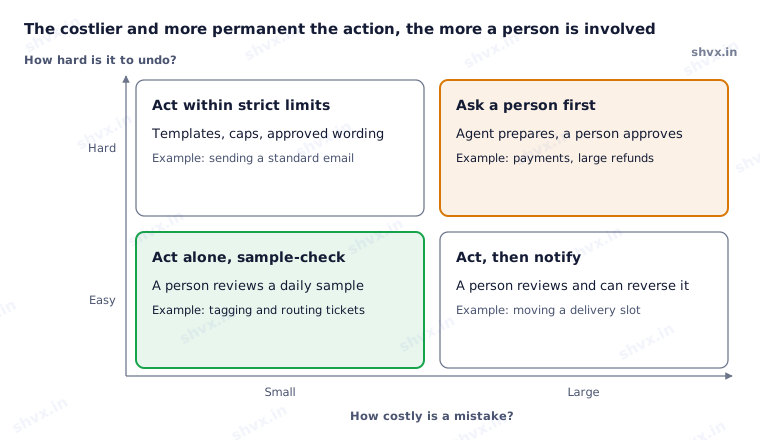
Place each action, not each agent, on the grid. Bottom-left actions need only a daily sample; top-right actions always wait for a person; the two other corners use limits or after-the-fact review.
An agent usually does several kinds of action, so it lands in several boxes at once. A support agent might answer questions alone, move a delivery slot and notify a person, and ask before any refund above a set amount.
What are the main patterns for human oversight of AI agents?
| Pattern | How it works | Best for |
|---|---|---|
| Approve before action | The agent prepares the action and the evidence; a person approves, edits or rejects | Costly or permanent actions |
| Review after action | The agent acts; a person checks within an agreed time and can reverse it | Costly but reversible actions |
| Exception queue | The agent hands over whenever it is unsure, information is missing or the customer is upset | Every agent, always |
| Sample audit | A person reviews a random sample of finished work every day | High-volume routine work |
How do you make human review of AI agents effective?
- Show the evidence. An approval screen should show a two-line summary, the sources, the proposed action and one-click approve, edit or reject. People can’t judge what they can’t see.
- Watch the override rate. If reviewers change many proposals, the agent isn’t ready for more freedom. If they approve everything in seconds for weeks, the check has become a rubber stamp; either loosen it or redesign it.
- Write the hand-off triggers down. “Hand over if the refund is above the limit, the customer mentions a complaint, or the source is missing” is testable. “Use judgement” is not.
- Turn every override into a test case, so the agent’s next version is checked against it; see how to test AI agents.
- Log who approved what, so audits run on records rather than memory.
- Check your obligations. Some regulations, such as the EU AI Act for high-risk uses, require human oversight. Confirm with your legal team which of your uses are covered.
How do you give an AI agent more autonomy safely?
Give an AI agent more autonomy one gate at a time: shadow mode, then draft and approve, then act with checks, then act within limits, moving up only on measured evidence.
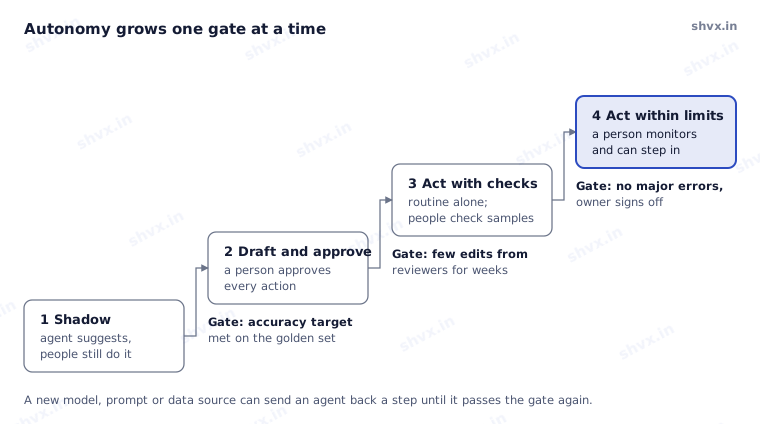
Each step up is earned with evidence, not granted on a date. Most agents should start at step 1 or 2 for each new action, even if they run at step 4 for older ones.
Freedom can also go down. A new model version, a prompt change or a new data source can send an agent back a step until it passes the gate again, which is why release discipline matters; see DevOps for AI agents.
What do people do as AI agents take on more work?
As agents handle more routine work, people move into three roles: supervising queues, reviewing quality and owning the agent’s targets. We cover that shift in AI in operations. For the accuracy side, see how to stop AI agents from making things up.
Common mistakes
- Approval on every step, so people stop reading what they approve.
- No approval on payments, deletions or anything legal.
- Approval screens with no evidence attached.
- Setting the oversight level once and never revisiting it.
- No record of who approved what, and when.
How SHVX can help
The right amount of oversight is what lets you scale an agent safely. Our Agent Assurance team designs oversight levels, approval flows and autonomy gates for your agents, and measures them over time.
Learn more about Agent Assurance.
FAQ
What is human in the loop AI?
A design where a person approves or completes certain steps before an AI system acts.
What is the difference between human in the loop and on the loop?
In the loop, a person must act before the step happens. On the loop, the agent acts and a person monitors and can intervene.
Does human review slow everything down?
Only if it is applied to every step. Applied to costly, permanent actions and a daily sample, it adds little delay.
When can we remove the person?
For a given action, when it meets agreed accuracy targets, reviewers rarely change its work for several weeks, and a mistake would be cheap and reversible.
Gartner figure checked in November 2026.