GraphRAG vs Hybrid RAG: Which One Does Your AI Assistant Need?
Most company assistants only need hybrid RAG, which is quicker and cheaper to build. GraphRAG earns its higher cost only when your questions connect many people, products or rules across many documents. Test your own questions before you pay for a graph.
The short answer: use hybrid RAG when the answer sits in one or two passages, such as a policy, a product spec or a clause. Use GraphRAG when the answer depends on how things connect across many documents, or on the whole collection at once. Start with hybrid RAG, then add a graph only for the question types that need it.
If you are building an AI assistant on your own documents, you will hear both terms within a week. Vendors pitch GraphRAG as the next step after RAG. GraphRAG is not a step up; it is a different tool for a different kind of question. Our Agent Engineering team builds both, and this guide explains how to tell which one your questions need.
Four words explained
- RAG (retrieval-augmented generation): the AI searches your documents first, then answers from what it found, like an open-book exam.
- Knowledge graph: a map of things and the links between them. “Supplier A makes Part 7.” “Rule 4.2 applies to Product X.”
- Entity: one thing on that map, such as a person, company, product, contract or rule.
- Community summary: a short summary, written in advance by an AI model, of a cluster of closely linked entities.
How does hybrid RAG work?
Hybrid RAG runs two searches at once: a keyword search for exact words, codes and names, and a meaning search for passages that say the same thing in different words. It merges the results, re-ranks them, and gives the best few passages to the model. We covered it in detail in How to Build an AI Chatbot That Reasons.
Hybrid RAG is fast, cheap to set up, and easy to keep current: when a document changes, you re-index that document. Hybrid RAG’s blind spot is any question whose answer is spread thinly across many places. Search returns the ten most similar passages; it does not follow a chain of links.
How does GraphRAG work?
GraphRAG builds a map before anyone asks a question.
- Extract. An AI model reads every document and lists the entities and relationships it finds.
- Connect. Those are joined into one knowledge graph, so “Acme Ltd” in a contract and “Acme” in an invoice become the same point on the map.
- Group and summarise. Closely linked entities are grouped into communities, and the model writes a summary of each one.
- Answer. Local search starts from the entities named in the question and walks their links. Global search reads the community summaries to answer questions about the whole collection, such as “what are the main themes here?”
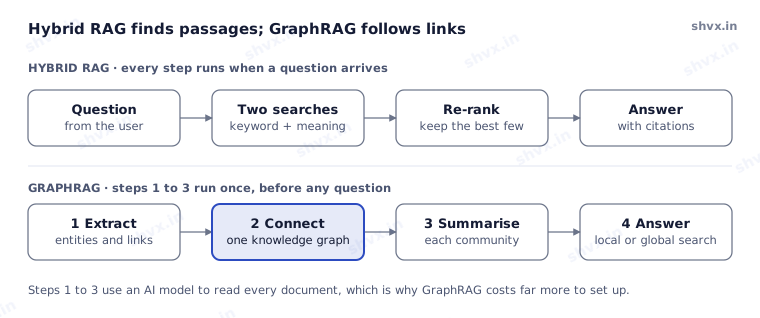
The top row does all its work when the question arrives, so it stays cheap and current. The bottom row builds a connected map in advance, which lets it answer questions that span many documents, at a much higher set-up cost.
When should you use GraphRAG instead of RAG?
Use GraphRAG instead of RAG when a question connects things across documents or covers a whole collection. The shape of the question decides, not the size of your document collection.
| Question type | Example | Best fit |
|---|---|---|
| Lookup | “What is the notice period in our standard contract?” | Hybrid RAG |
| Exact code or name | “Is part XR-220 compatible with the 2024 model?” | Hybrid RAG (keyword side) |
| Connect the dots | “Which suppliers depend on a factory named in the new safety rule?” | GraphRAG local search |
| Whole collection | “What are the top complaint themes across this quarter’s tickets?” | GraphRAG global search |
| Counts and totals | “How many open claims are over $10,000?” | Neither: query the database |
Counts and totals are the exception. If the answer lives in a database, the assistant should run a database query through a tool. Neither kind of RAG is good at counting.
How much does GraphRAG cost?
GraphRAG costs far more to set up than hybrid RAG, because an AI model must read every document to build the graph. In Microsoft Research’s LazyGraphRAG benchmark, the lighter LazyGraphRAG method indexed data at the same cost as vector RAG, and at 0.1% of the cost of full GraphRAG. Put the other way, a full graph cost about a thousand times more to build than a plain search index on that test.
Three running costs are easy to miss:
- Refresh. When documents change, parts of the graph and its summaries must be rebuilt.
- Extraction errors. If the model links the wrong two entities, every answer that walks that link inherits the mistake.
- Global questions. Reading many community summaries for one answer uses far more tokens than a normal search.
Newer methods such as LazyGraphRAG cut these costs by doing less work up front and more at question time. The benchmark above reports quality comparable to full global search at more than 700 times lower query cost. Re-test any vendor claim on your own documents.
What are the best use cases for GraphRAG and hybrid RAG?
| Use case | Typical question | Best fit and why |
|---|---|---|
| HR and policy assistant | “How many days of parental leave do I get?” | Hybrid RAG: the answer is one passage |
| Product support | “What torque does part XR-220 need?” | Hybrid RAG: exact codes need keyword search |
| Regulatory compliance mapping | “Which of our controls cover this new rule, and who owns them?” | Graph: rules, obligations, controls and owners form a chain |
| Supplier risk | “Which products are exposed if this region shuts down?” | Graph: the answer is several links away |
| Fraud and due diligence | “Is this new customer linked to any flagged company?” | Graph: shared directors, addresses and accounts are links |
| Voice-of-customer research | “What are customers unhappy about this quarter?” | GraphRAG global search: needs the whole collection |
Can you use GraphRAG and hybrid RAG together?
Yes: the best production systems use GraphRAG and hybrid RAG together, with a router in front.
- Start with hybrid RAG and a golden set of 100 real questions. Add a graph only when the failures cluster on connect-the-dots or whole-collection questions.
- Build the graph from data you already have. Your CRM, ERP and product catalogue already hold clean relationships. Use an AI model to extract only what lives in free text.
- Fix the map’s vocabulary first. Decide the entity and relationship types up front (an ontology). A graph where the model invents its own types becomes noisy fast.
- Let the planner route. The planning step from our hybrid RAG design decides per question: hybrid search, graph, or database.
- Carry permissions into the graph. A user who can’t open a document must not reach its facts through a link either.
- Clean documents first. Graph extraction is only as good as the text it reads; see How to Extract Data from Large, Complex Documents.
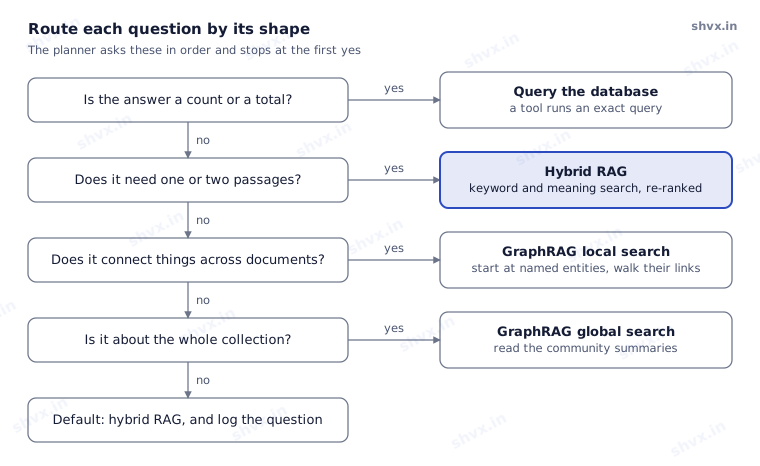
Most questions stop at the second check, which is why hybrid RAG is the default. The graph only handles the questions that genuinely need links or the whole collection, so you pay its cost only where it adds value.
Common mistakes
- Building a full graph before testing whether hybrid RAG already answers the questions.
- Letting the model invent entity types with no agreed schema.
- Using RAG of any kind for counts and totals that a database can answer exactly.
- Forgetting that the graph needs refreshing, and budgeting only for the first build.
How SHVX can help
Choosing the wrong retrieval design costs months. Our Agent Engineering team takes a sample of your real questions and documents, tests hybrid RAG and a graph approach side by side, and gives you a written recommendation with accuracy and cost per question.
Learn more about Agent Engineering.
FAQ
Is GraphRAG better than RAG?
Not in general. It is better for questions that connect many entities or cover a whole collection. For single-fact lookups, hybrid RAG is faster and cheaper.
Do I need a graph database?
Only if you use the graph often and at scale. Small graphs can live in a normal database or in files; add a graph database when queries that walk many links get slow.
What is LazyGraphRAG?
A lower-cost variant from Microsoft Research that skips most of the up-front summarising and does the work when a question arrives.
Can I use both together?
Yes, and most mature systems do. A router sends each question to the method that suits it.
Figures checked against Microsoft Research’s published benchmark in November 2026.