AI in Operations: How Automation Lets Ops Teams Do More with Less
The short answer: AI is moving operations from people doing every step to people supervising the exceptions. Agents now handle routine, rule-heavy, high-volume work end to end: reading documents, updating systems, answering tickets. That lets the same team absorb growth without hiring at the same pace. Start where volume is high and rules are clear, keep people on the exceptions, and measure cost and quality per transaction.
Operations leaders hear two stories at once. One says automation will transform the function: Gartner predicts that by 2029 agentic AI will resolve 80% of common customer service issues without human help, cutting operational costs by 30%. The other says most efforts stall: in McKinsey’s State of AI 2025, 62% of organisations were experimenting with AI agents, but no more than 10% were scaling agents in any single function. Our Agent Operations team helps operations leaders close that gap.
What can AI automate in operations today?
AI agents can now automate whole operational tasks, not just fixed clicks: they read, decide within rules, act in systems and hand off exceptions. Automation itself is not new; what changed is which work it can take on.
| Wave | What it automated | Where it broke |
|---|---|---|
| Scripts and screen bots (software that copies keystrokes) | Fixed, repetitive clicks | Any change in a screen or format; every exception went to a person |
| AI assistants | Drafting and summarising for a person | The person still did the work |
| AI agents | Whole tasks: read, decide within rules, act in systems, hand off | Needs clean data, testing, limited permissions and monitoring |
The exceptions that used to break software robots, such as a new invoice layout or a slightly unusual request, are exactly what agents can now handle. Handling those exceptions is why the gains are bigger this time, and why the controls matter more.
How does an operations team work with AI agents?
With AI agents, an operations team moves from doing every step to supervising: agents finish the cases they are sure of, and people handle the exceptions.
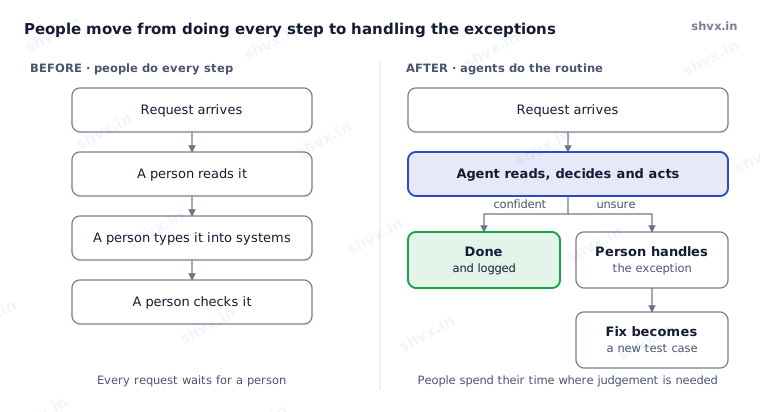
On the left, every request queues for a person at three steps. On the right, the agent finishes the cases it is sure of, people take the rest, and every fix they make becomes a test that makes the next run better.
Three roles appear in most teams that make this work:
- Agent supervisor: watches the queues, handles hand-offs and unblocks stuck work.
- Quality reviewer: checks a sample of the agent’s work every day and feeds corrections back as test cases.
- Automation owner: owns the targets, the running cost and every change to the agent.
“Doing more with less” in practice means the same team handles more volume, cycle times shrink, and people spend their day on judgement instead of data entry. It rarely means fewer people overnight; the people who know the exceptions are the ones who teach the agent.
Which operations processes should you automate first?
Automate high-volume work with clear rules first, such as password resets, invoice reading and payment matching.
| Area | Routine work agents take on | What stays with people |
|---|---|---|
| Service desk | Password resets, status questions, triage and routing | Outages, upset or vulnerable customers |
| Back office | Reading invoices and onboarding documents, data entry | Disputes and unusual cases |
| Finance operations | Matching payments to invoices, reconciliation | Write-offs and approvals above limits |
| IT operations | Incident triage, log summaries, standard runbook steps | Changes to production systems |
| Compliance | Tracking rule changes, mapping them to controls | Judgement calls and sign-off |
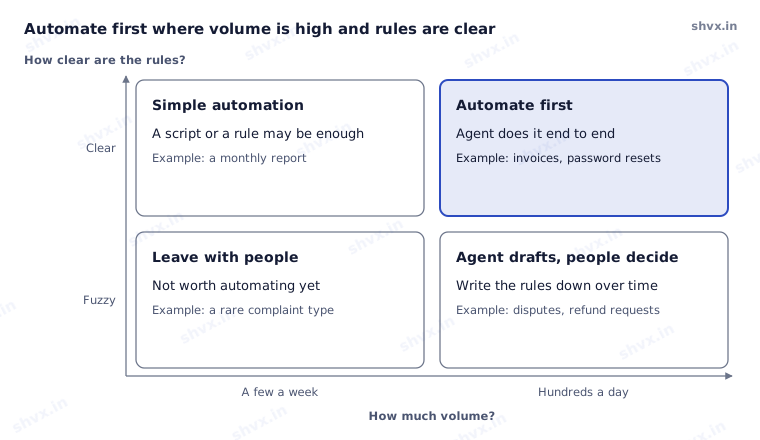
Place each process on the grid. Start in the top-right corner, where the payback is fastest and mistakes are easiest to spot; move work from the bottom-right up as your team writes the rules down.
How do you automate an operations process with AI?
Automating one operations process with AI takes five steps: measure it today, get the data agent-ready, automate the routine path, test before every release, and run it like a service.
- Measure it today. Volume, cost per transaction, cycle time and error rate. Without a baseline, no one can prove the gain.
- Get the data agent-ready. Most failures start with messy documents and records; see AI document extraction for large documents.
- Automate the routine path and design the hand-offs. Decide which steps the agent does alone and which need a person; see human in the loop AI.
- Test before every release. Use real cases and agreed targets, as in how to test AI agents.
- Run it like a service. Monitor quality and cost per task, keep someone on call, and review monthly; see DevOps for AI agents.
How do you measure doing more with less?
Doing more with less shows up in five numbers:
- Cost per transaction, including the agent’s running cost (see the cost of running AI agents).
- Straight-through rate: the share of cases finished with no person involved.
- Cycle time from request to done.
- Quality: error and rework rates, checked on a daily sample.
- Volume handled per person, tracked over months as volume grows.
Hours “saved” on paper don’t count unless one of these numbers moves.
Common mistakes
- Automating a broken process as it is, instead of simplifying it first.
- Counting headcount instead of cost and quality per transaction.
- No named owner for the agent after go-live.
- Moving the people who know the exceptions before the agent has learned them.
How SHVX can help
Automating one process is a project; running agents across operations is a service. Our Agent Operations team monitors agents in production, fixes issues when they fail, manages model upgrades and reviews cost with you every month.
Learn more about Agent Operations.
FAQ
What is AI in operations?
Using AI, and increasingly AI agents, to carry out routine operational work such as tickets, documents and reconciliations, with people handling the exceptions.
Will AI agents replace operations teams?
They change the work more than they remove it. People move from keying data to supervising queues, reviewing quality and improving the process.
Which processes should we automate first?
High-volume work with clear rules and clean data, where a mistake is easy to spot and fix.
How do we know it’s working?
Cost per transaction falls, the straight-through rate rises, and quality holds or improves on a daily sample.
Figures checked against Gartner and McKinsey publications in November 2026.