AI-Ready Data: A 10-Point Checklist for AI Agents
The short answer: AI-ready data is data an AI agent can find, read, trust and is allowed to use. In practice that means ten things: you know where it lives, it is readable, its structure is kept, its references are linked, versions are clear, it is labelled, access is controlled, personal data is handled, you have checked answers to test against, and it stays current. Score yourself on each, then fix the weakest before you build.
Most AI agent projects that stall do so on data, not on the model. Gartner predicted that through 2026, organisations will abandon 60% of AI projects unsupported by AI-ready data. This checklist helps a founder or operations head judge their own data in an afternoon. Making data agent-ready is the core of our Agent-Ready Data work, and the starting point of our guide series, From raw data to trusted AI agents.
How to use this checklist
Pick one process you want to automate. For each point, score your data 0 (not in place), 1 (partly) or 2 (in place). A total of 15 or more means you can start a pilot; under 10 means fix the data first.
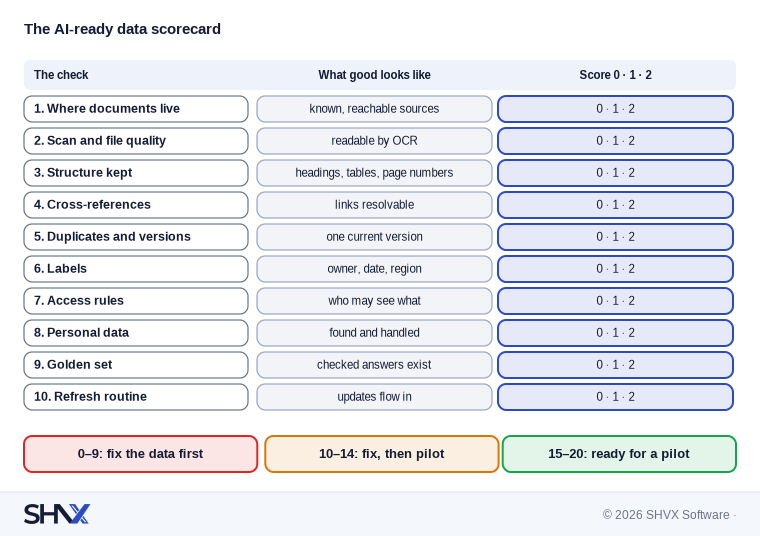
1. Do you know where the data lives?
Good: one list of the systems, folders and inboxes the process uses, with an owner for each.
Warning sign: “It’s somewhere in shared drives and people’s email.”
2. Can a machine read it?
Good: digital files, or scans clean enough for OCR (software that reads text from images); handwriting identified as such. Turning these into structured data is what the industry calls intelligent document processing (IDP).
Warning sign: faxes, phone photos and photocopies nobody has ever tried to read automatically.
3. Is the structure kept?
Good: headings, tables and page numbers survive conversion, so a table stays a table.
Warning sign: files converted to plain text that scrambles tables. See extracting data from large, complex documents.
4. Are cross-references linked?
Good: “see Section 4.2” and defined terms can be followed to their target.
Warning sign: answers that depend on an appendix the system never reads.
5. Is it clear which version is current?
Good: one current version, with older ones archived and dated.
Warning sign: five copies of the same policy with different dates and no way to tell which applies.
6. Is it labelled?
Good: each document carries basic metadata: type, owner, date, product, region.
Warning sign: file names like final_v3_NEW.pdf are the only labels.
7. Is access controlled?
Good: permissions that reflect who should see what, which the agent will inherit.
Warning sign: “anyone with the link” folders. See AI agent permissions and access control.
8. Is personal data handled?
Good: you know which documents hold personal data, why you hold it and how long you keep it, and you can mask it where it isn’t needed.
Warning sign: nobody can say which folders contain customer IDs or health details.
9. Do you have checked answers to test against?
Good: a golden set of 30 to 50 real cases, including the worst ones, with answers a person has checked.
Warning sign: success will be judged by a demo. See how to test AI agents.
10. Will it stay current?
Good: a routine for adding new documents, retiring old ones and re-testing after changes.
Warning sign: a one-off data clean-up with no owner afterwards.
What should you fix first?
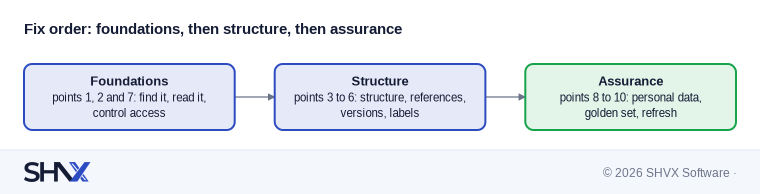
Fix in this order: find it, make it readable and control access; then keep its structure, link references, settle versions and add labels; then handle personal data, build the golden set and set up a refresh routine. Data readiness is not a one-off project: it continues through testing and support, which is why our pilots build it in from week one, as described in why AI pilots fail to reach production.
Common mistakes
- Starting the build before scoring the data.
- Cleaning every document in the company instead of the ones one process needs.
- Testing on clean samples, then meeting the messy reality in production.
- Treating data readiness as done after launch.
How SHVX can help
Not sure your data is ready for an AI agent? Send 10 of your documents. We’ll score them against this checklist and tell you what to fix first.
Learn more about Agent-Ready Data.
FAQ
What is AI-ready data?
Data an AI agent can find, read, trust and is allowed to use: readable, structured, current, labelled, access-controlled and testable against checked answers.
How do I know if my data is ready for AI?
Score one process against the ten points in this checklist. Fifteen or more out of 20 means you can start a pilot.
What is the difference between AI-ready and agent-ready data?
Agent-ready data adds what agents need to act safely: permissions, linked references and a golden test set, not just clean text.
How long does it take to make data AI-ready?
It depends on volume and quality. Scoping it for one process usually takes days, not months, when you start with the checklist.