Why AI Agent Pilots Never Reach Production (and How to Get Yours There)
The short answer: pilots stall for five reasons that have little to do with the AI model: no measured business case, data that isn’t ready, quality nobody measures, missing risk controls, and nobody to run the agent afterwards. A pilot proves an agent can work on a good day; production needs proof that it keeps working every day. Build production’s requirements into the pilot from week one, and agree the go/no-go tests before you start.
The gap between trying AI agents and running them is wide. In McKinsey’s State of AI 2025, 62% of organisations were experimenting with agents, but no more than 10% were scaling them in any single function. Gartner expects over 40% of agentic AI projects to be cancelled by the end of 2027 because of rising costs, unclear value or weak risk controls. Our Agent Engineering team designs pilots that ship, and the causes below are what we see stall the rest.
Four words explained
- Pilot: a limited trial of an agent with real users, meant to decide whether to launch it.
- Production: the agent running for real, every day, with people depending on it.
- Golden set: a fixed list of real tasks with agreed correct answers, used to score the agent.
- Go/no-go gate: the agreed test the pilot must pass before anyone funds the launch.
What is the difference between an AI pilot and production?
A pilot proves an agent can work on a good day; production needs proof that it keeps working every day, on real data, with controls, monitoring and an owner.
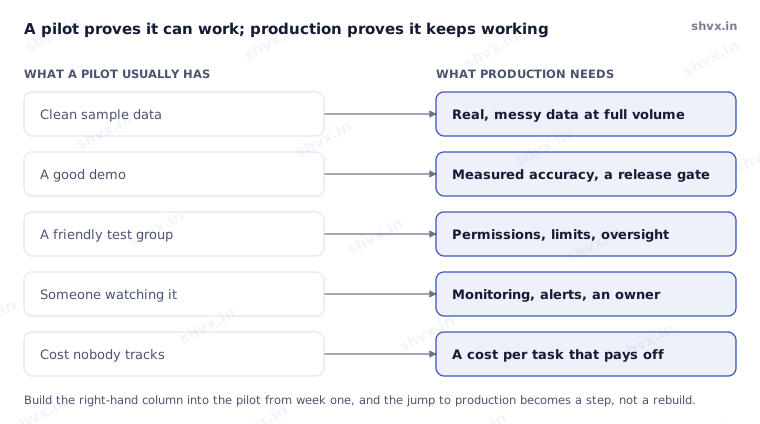
Most pilots are built to impress, not to launch. Pilots typically run on hand-picked data with a friendly group of users while the builders watch every answer. All five items on the right are then discovered after the pilot is declared a success, which is when budgets and patience run out.
Why do AI agent pilots fail to reach production?
AI agent pilots usually stall for five reasons: no business case, data that isn’t ready, unmeasured quality, missing risk controls and nobody to run the agent.
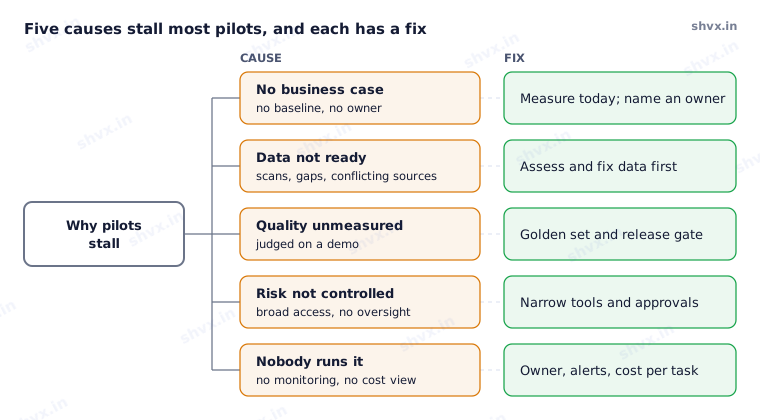
1. No business case
Nobody measured the process before the pilot, so nobody can prove the gain after it. Measure cost, time and error rates first, and name one business owner for the outcome; AI in operations lists the numbers to track.
2. Data not ready
The pilot used clean samples; real documents are scans, gaps and conflicting versions. Gartner predicts that through 2026 organisations will abandon 60% of AI projects unsupported by AI-ready data. Start with AI document extraction for large documents.
3. Quality nobody measures
In LangChain’s survey of agent builders, quality was the top barrier to production, yet only 52% ran offline evaluations. Build a golden set during the pilot and make it the release gate; see how to test AI agents and how to stop AI agents from making things up.
4. Risk controls missing
Security and compliance see the agent for the first time a week before launch, and find a shared admin account and no approvals. Bring them in during the pilot; see AI agent permissions and human in the loop AI.
5. Nobody to run it
The builders move on, and nobody owns monitoring, model upgrades or the monthly bill. Name the owner and plan operations before launch; see DevOps for AI agents and the cost of running AI agents.
How do you design an AI pilot that reaches production?
Design an AI pilot that reaches production by building production’s requirements into it from week one:
- Use real data, including the worst scans and oddest cases, from day one.
- Agree the go/no-go tests up front: accuracy on the golden set, cost per task, and the business measure that must move.
- Connect one real system, not a mock-up, so integration problems surface early.
- Run the security review in parallel, not at the end.
- Track cost per task throughout the pilot, not just the total spend.
- Name the owner who will run the agent after launch, and involve them now.
- Write the day-one plan: who watches it, who is on call, and how to roll back.
Common mistakes
- Declaring success on a demo with hand-picked examples.
- Starting with the hardest, most visible process instead of a narrow, measurable one.
- Letting the pilot run on with no decision date.
- Treating launch as the finish line instead of the start of operations.
How SHVX can help
If your pilot looks good but nobody will sign off the launch, one of the five causes is usually the reason. Our Agent Engineering team designs pilots with production built in, and works with our Agent-Ready Data, Agent Assurance and Agent Operations teams to close each gap.
Learn more about Agent Engineering.
FAQ
Why do AI pilots fail to reach production?
Usually not because of the model, but because of unmeasured value, unready data, unmeasured quality, missing risk controls and no plan to run the agent.
What is pilot purgatory?
A pilot that keeps running without a launch decision, because nobody agreed what success looks like.
How do we know a pilot is ready for production?
It passes agreed tests on real data: accuracy on a golden set, an acceptable cost per task, security sign-off, and a named owner.
Should we pilot several agents at once?
Start with one narrow, measurable process. A clear first win funds the next.
Survey and forecast figures checked in November 2026.