EU AI Act Compliance for AI Agents: A Founder's Guide
The short answer: under the EU AI Act, what matters is what your agent is used for. Most business agents carry light duties, mainly telling people they’re dealing with AI, which has applied since 2 August 2026. Agents used in areas such as hiring, credit decisions or life and health insurance pricing count as high-risk, and their main obligations now apply from 2 December 2027 after the Digital Omnibus. Privacy law such as GDPR applies to any agent that touches personal data, whatever its risk tier.
Founders building or buying AI agents hear two opposite messages: “the AI Act has been delayed” and “you’re already late”. Both are partly true. This guide explains EU AI Act compliance in plain words: what applies to one agent today and what’s coming. It sits in our Agent Assurance work, where we test agents for safety and trust. This is not legal advice: confirm your obligations with counsel in each market you serve.
How does the AI Act classify AI agents?
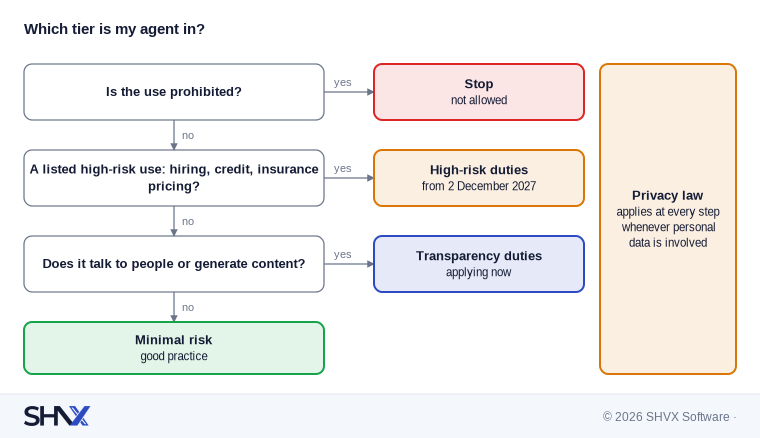
The AI Act sorts AI by use, not by technology. An agent built on the same model can sit in different tiers depending on its job:
| Tier | Examples of agent use | What it means |
|---|---|---|
| Prohibited | Manipulating people, social scoring, certain biometric uses, generating non-consensual intimate images | Not allowed |
| High-risk | Screening job candidates, assessing creditworthiness, pricing life or health insurance | Risk management, human oversight, logging, documentation, accuracy testing |
| Transparency | Agents that talk to people, or create text, images or voice | Tell people they’re dealing with AI; mark generated content |
| Minimal | Internal document sorting, summarising, routing | No specific duties beyond good practice and AI literacy |
What changed with the Digital Omnibus?
The Digital Omnibus on AI, Regulation (EU) 2026/1744, entered into force on 27 July 2026. For founders, the key dates are now:
- Already applying: prohibited practices and AI literacy (since February 2025; the Omnibus softened the literacy duty), and rules for general-purpose AI models (since August 2025).
- Since 2 August 2026: the Article 50 transparency duties, including telling people they’re interacting with an AI system. The Omnibus did not defer these.
- Since 2 December 2026: machine-readable marking of AI-generated content also applies to systems already on the market before August 2026, and two new prohibitions added by the Omnibus apply: AI that creates non-consensual intimate images and AI that creates child sexual abuse material.
- 2 December 2027: obligations for standalone high-risk systems, such as hiring and credit uses.
- 2 August 2028: obligations for high-risk AI built into regulated products.
So the delay is real, but only for high-risk duties. If your agent talks to customers, the transparency duty applies today.
What do high-risk obligations mean in plain words?
If your agent is high-risk, you’ll need to show:
- Risk management: you’ve listed what could go wrong and how you limit it.
- Data quality: training and test data are relevant and checked for bias.
- Human oversight: a named person can understand, override and stop the agent, as in human in the loop AI.
- Logging: the agent’s decisions can be traced after the fact.
- Documentation and accuracy: you can explain how it works and prove how well, using tests like those in how to test AI agents.
Our guide to AI resume screening shows what this looks like for a hiring agent.
What does privacy law add?
Privacy law applies to any agent that reads personal data, in every tier. Under GDPR in Europe and India’s Digital Personal Data Protection Act (DPDPA), the basics are similar:
- A lawful reason for processing the data, and consent where that is the basis.
- Only the data the job needs. Mask or leave out the rest.
- Know where data and models run, and what your vendors’ terms say about storage and training.
- Respect people’s rights to access, correct and delete their data.
- Log and mask: keep an audit trail, without copying personal data into logs and prompts.
Off-the-shelf assistants raise the same questions; see is it safe to connect AI to your email and drive?
An EU AI Act compliance checklist for one agent
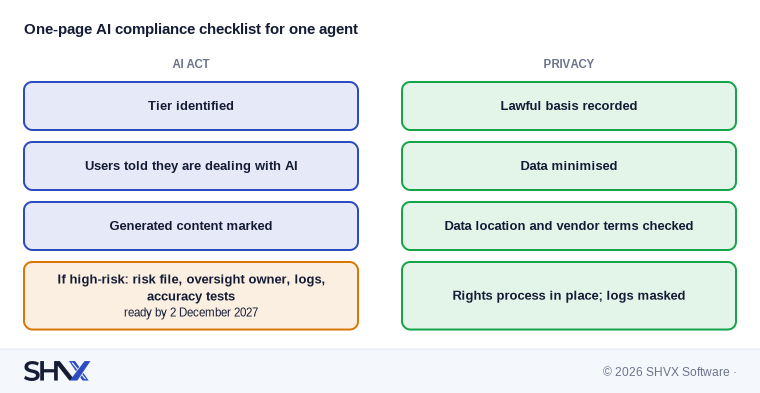
- Write down what the agent does, for whom, and with what data.
- Decide its AI Act tier and record why.
- Make sure people are told when they’re dealing with AI.
- Record the lawful basis for each kind of personal data.
- Cut the data to what the job needs.
- Check where data and models run, and your vendors’ terms.
- Name an owner who can override and stop the agent.
- Keep traceable logs without exposing personal data.
- Test accuracy and bias before launch and after every change.
- Review it all when the agent’s job changes.
Compliance is also our home ground: see how we turn regulations into tracked obligations on our compliance page.
Common mistakes
- Assuming the delay covers everything, when transparency duties already apply.
- Classifying by technology instead of by use.
- Forgetting privacy law because the agent is “low risk” under the AI Act.
- Sending personal data to tools with unclear terms.
- No named owner who can stop the agent.
Legal references checked on 22 November 2026 against the Omnibus (Regulation (EU) 2026/1744). Not legal advice.
How SHVX can help
Planning an agent that touches personal data or a high-risk use? We’ll check its AI Act tier and privacy setup and send you a written list of gaps in priority order.
Learn more about Agent Assurance.
FAQ
Does the EU AI Act apply to my AI agent?
If you offer it in the EU or its output is used there, likely yes. What you must do depends on its use: most agents carry only transparency duties.
When do EU AI Act high-risk obligations apply?
After the Digital Omnibus, from 2 December 2027 for standalone high-risk systems such as hiring and credit uses, and from 2 August 2028 for AI built into regulated products.
Do I have to tell customers they are talking to an AI agent?
Yes, in most cases. This Article 50 duty has applied since 2 August 2026.
Is an AI agent that screens resumes high-risk?
Yes. Hiring uses are listed as high-risk, so plan for oversight, logging, documentation and bias testing.