KYC Automation with AI: Faster Customer Onboarding
The short answer: KYC automation with AI means a pipeline reads every onboarding document, pulls out the details each application needs, checks that they agree across documents, and sends only unclear files to a person. Clean files stop waiting in a queue for someone to retype them, errors are caught before they reach core systems, and every value links back to the page it came from. Your compliance team keeps every decision.
Opening a loan, an insurance policy or an account starts with paperwork: application forms, identity and address proofs, income documents and bank statements. Customers send them as clean PDFs, phone photos, faded copies and handwritten forms. This guide is for operations and compliance heads who want onboarding to move faster without weakening their checks. It sits in our Agent-Ready Data work, because in KYC the hard part is getting the customer’s data right.
Why is manual KYC so slow?
- Every file is different. Each customer sends a different mix of documents, in a different order and quality.
- People retype the same details many times. Name, date of birth, address and ID numbers are copied from each document into the onboarding system.
- Small errors surface late. A swapped digit or a misspelt name becomes a compliance query or a rejected application weeks later.
- Queues build up. Every file waits for a person, including the clean ones.
The cost of that delay is well documented. In a 2022 Signicat study, 68% of European consumers said they had abandoned a financial application in the past year. For corporate clients, a 2023 Fenergo survey of bank executives put the average KYC review at 95 days and about $2,598.
What does an AI KYC pipeline do?
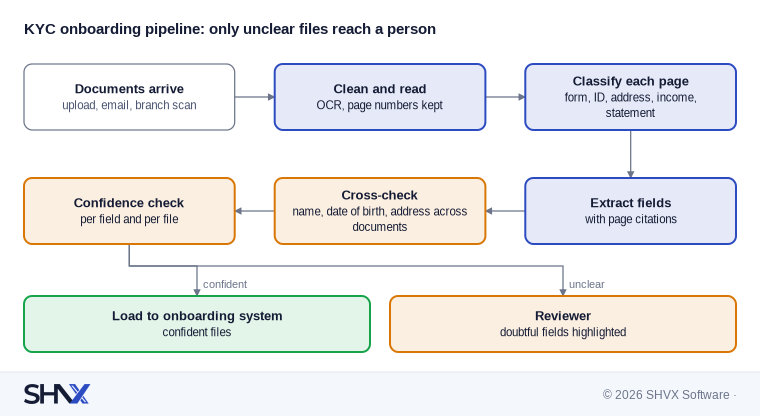
- Read anything. Poor scans, photos and handwriting are cleaned and read, with the page number kept for every value.
- Know what each page is. Each page is sorted into a document type.
- Pull out the right fields. Name, date of birth, ID numbers, address, income and amounts, each with the page it came from.
- Check the story adds up. The same person must appear on every document. Dates must be valid, required documents present and totals consistent.
- Ask for help only when needed. Each file gets a confidence score. Confident files flow through; unclear ones go to a reviewer.
The industry name for steps 1 to 3 is intelligent document processing (IDP). In KYC, the checks in step 4 are what make it worth doing.
What does a person still decide?
KYC is a regulated control, so the pipeline prepares and checks, and people decide:
- whether the customer is accepted;
- what to do with files the pipeline flags;
- risk ratings and enhanced checks for higher-risk customers;
- anything that needs a conversation with the customer.
Identity verification itself, such as liveness checks and matching a selfie to an ID, is a separate, specialised step. Most firms use a dedicated provider for it and feed its result into the same file.
What data and controls must be in place?
- A clear list of documents per product, so the pipeline knows what complete looks like.
- Field definitions agreed with compliance: which name, which address, which date.
- A golden set of 30 to 50 past files, including your worst scans, with checked answers.
- Data staying in your environment, with approved models only and no training on customer data.
- An audit trail: what was read, what was flagged, who reviewed it and when.
How do you start?
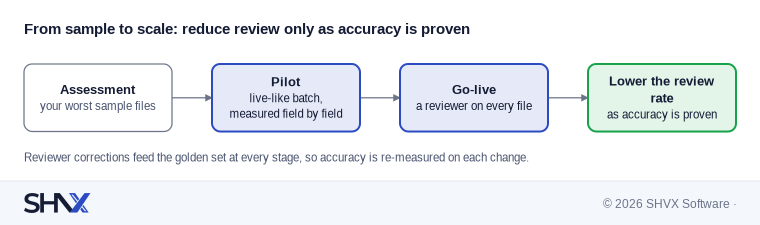
Start with one product and its documents. Run past files through the pipeline and compare the output with what your team recorded. Go live with a person reviewing every file, then lower the review rate only where accuracy is proven. Every correction becomes a new test case.
The same verified records can then feed underwriting, credit and customer-service agents. For lenders, our bank statement analysis guide covers the income side, and the lending page shows how the pieces fit. Insurers can see our insurance page. The technical checks are in our companion post, KYC Document Verification with AI.
Common mistakes
- Testing on clean samples instead of your worst real files.
- Treating an unreadable field and an empty field as the same thing.
- Letting the pipeline accept customers on its own.
- Sending customer documents to tools with unclear data terms.
How SHVX can help
Onboarding stuck behind manual data entry? Send five anonymised customer files, including your worst scans. We’ll show you field-level accuracy before you commit.
Learn more about Agent-Ready Data.
FAQ
What is KYC automation?
Using software to read, extract and check customer onboarding documents, so people review exceptions instead of retyping every file.
Can AI fully automate KYC?
It can automate the reading and checking. Accepting a customer, risk ratings and flagged cases stay with trained people.
How do banks and lenders use AI for customer onboarding?
To classify documents, extract fields with page citations, cross-check details across documents and route unclear files to a reviewer.
Is customer data safe in an AI KYC pipeline?
It should stay in your own environment, with approved models only and no training on your data. Ask any provider to confirm this in writing.