Multilingual AI Voice Agents for Customer Service
The short answer: a multilingual AI voice agent understands and replies in the customer’s own language, by phone or text, including when customers mix two languages in one sentence. Build it on one shared knowledge base, handle each language natively where quality allows and translate only where it doesn’t, test every language separately with real customer messages and calls, and hand over to a person who speaks the language whenever the agent is unsure.
Customers ask more, buy more and complain less when they can speak their own language. For many businesses, that means supporting several languages on the phone and in chat, which used to require a separate team for each. This guide is for customer-service and CX heads weighing multilingual AI agents. It sits in our Agent Engineering work. If you are still choosing the channel, start with text or voice: which AI agent fits your customers.
What makes multilingual service hard?
- Mixed-language speech. Many customers switch between two languages mid-sentence, often using English for product names, numbers and technical words.
- Scripts and transliteration. In text, customers may write their language in its own script or in Latin letters, and spell the same word several ways.
- Accents and phone audio. Speech recognition that works on clear studio audio can struggle with a noisy line and a strong regional accent.
- Names, numbers and addresses. These must be captured exactly, in any language.
- Uneven quality. A model can be excellent in one language and weak in another.
Translate or handle each language natively?
| Approach | How it works | Best when |
|---|---|---|
| Native | The agent understands and answers directly in the customer’s language | Major languages where models perform well |
| Translate in the middle | Speech or text is translated to one working language, answered, then translated back | Smaller languages with weaker model support |
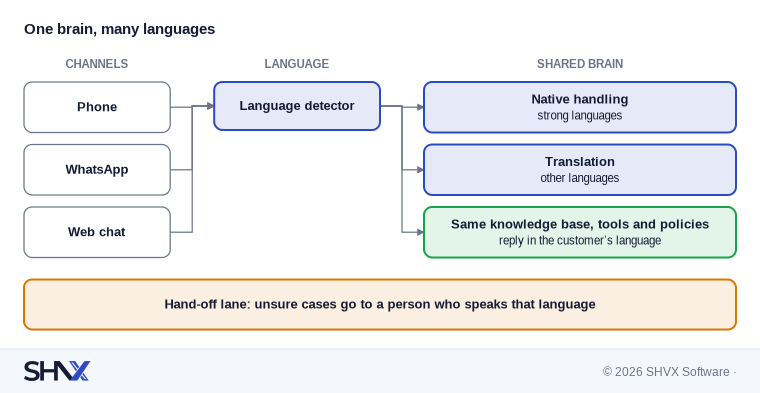
| Hybrid | Native for common languages, translation for the rest | Most real deployments |
Whichever you choose, keep one knowledge base with approved answers, so the facts are identical in every language.
What does voice add?
Voice raises the bar. Callers notice a delay of even a second, so every step, from speech recognition to the reply, must be fast. Speech recognition has to be tested per language and accent on real phone audio, not studio samples. Names and numbers should be read back for confirmation. Our guide to building an after-hours voice agent covers the speed targets and escalation design in detail.
How do you test each language?
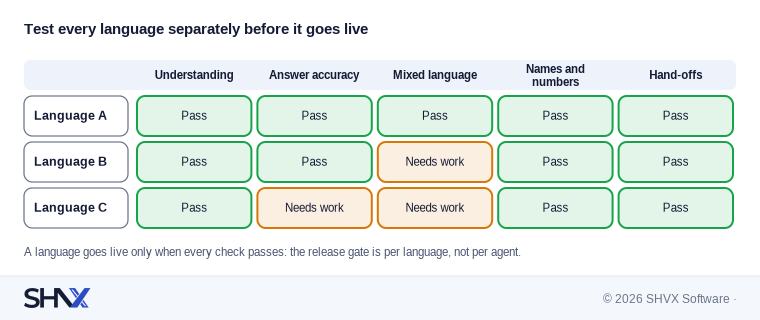
- Collect real messages and calls in each language, including mixed-language ones and poor audio.
- Have a native speaker grade a sample for each language. An AI judge helps at volume, once it agrees with your human graders.
- Track per language: intent understood, answer correct, names and numbers exact, and hand-offs correct.
- Launch language by language, starting with your largest, and add the next only when the first meets its targets.
Our guide to testing AI agents explains how to automate these checks.
When should the agent hand over to a person?
Always when it’s unsure what the customer means, when the customer asks for a person, when emotions run high, or when the request involves money, complaints or legal matters. Route the hand-off to someone who speaks the customer’s language, and pass on a summary so the customer doesn’t repeat themselves. See human in the loop AI for setting these rules.
Common mistakes
- Testing only in English and assuming other languages behave the same.
- Separate knowledge bases per language that drift apart.
- Ignoring mixed-language messages, which are often the majority.
- Handing over to a person who doesn’t speak the customer’s language.
- Launching every language at once.
How SHVX can help
Want to serve customers in their own language without a team per language? Send 20 real customer messages or call recordings. We’ll test how an agent handles them, language by language, and show where it needs a person.
Learn more about Agent Engineering.
FAQ
What is a multilingual voice agent?
An AI agent that understands and answers customers by phone in several languages, including mixed-language speech, using one shared knowledge base.
Can AI handle customers who mix two languages?
Modern models often can, but quality varies by language pair. Test it on your own real messages before launch.
Is it better to translate or answer natively?
Native handling usually sounds better and keeps meaning; translation helps for languages with weaker model support. Most deployments mix both.
How do you test a multilingual AI agent before going live?
Grade real messages and calls per language with native speakers, track intent, accuracy and hand-offs, and launch one language at a time.