Small Language Models for Document Processing: Agent-Ready Data at a Fixed Cost
Before AI agents can use your company’s documents, someone has to sort, clean and structure them. Most of that work is repetitive, and paying a large AI model per page for it gets expensive fast. Small models on a fixed-price server can take on much of it, at a cost you can budget.
The short answer: getting enterprise data ready for AI agents is mostly high-volume, narrow work: sorting pages, finding headings, tagging documents and pulling simple fields. Small language models (SLMs) suit those jobs, run on one fixed-price server, and keep your documents inside your own environment. Save the large models for the hard cases. Our Agent-Ready Data team works with any small model: we test candidates on your documents and choose the one that fits each job.
Why is data preparation a cost trap?
Agents are only as good as the data behind them, so every AI project starts by preparing documents. That work has three features that make per-use AI pricing painful:
- Volume. A backlog of thousands or millions of pages, plus new documents every month.
- Every page, every step. Sorting, reading structure, tagging and extracting each touch every page (see How to Extract Data from Large, Complex Documents with AI).
- Re-runs. When you improve a step, you run the documents again, and pay again.
With pay-per-use models, the bill grows with every page and every re-run. That makes data preparation one of the hardest AI costs to forecast.
Why do small models fit document work?
- The tasks are narrow. The answer is a label, a heading, a date or a reference number, not an essay.
- Consistency beats brilliance. The same task runs thousands of times; doing it the same way every time matters more than deep reasoning.
- Documents stay private. A small model runs on your own server, so contracts, records and customer files never leave it.
- The cost is fixed. One server processes the backlog and the monthly flow for the same price, and a re-run costs nothing extra.
Which document jobs suit a small model?
| Job | Example | Small model? |
|---|---|---|
| Page and document sorting | Invoice, contract, ID proof, statement | Usually a good fit |
| Structure detection | Headings, sections, lists, alongside layout tools | Usually a good fit |
| Simple field extraction | Dates, reference numbers, names, amounts, into a fixed schema | Usually a good fit |
| Cleanup and tagging | Fixing OCR noise; adding product, region and date tags | Usually a good fit |
| Short summaries for search | A two-line summary per section | Test on your own data |
| Cross-references and hard judgement | Rules split across sections, complex tables | Send to a stronger model |
How does routing by difficulty work?
You don’t have to choose one model for everything. Let the small model do the bulk, check its confidence, and pass only the unsure cases on.
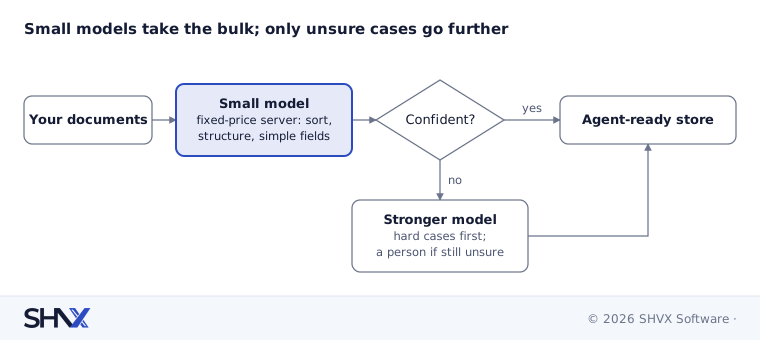
Confident results go straight to the agent-ready store; only the unsure ones reach a stronger model, and a person after that if needed.
How do we evaluate a small model for a data job?
- Pick one job and build a golden set: 30 to 50 real documents where a person has written down the correct answers.
- Run a small model and a strong model on the same set.
- Score field by field: how many values each got right, missed or invented.
- Check the practical tests: a licence that allows commercial use, a fit on the fixed server, valid structured output every time, and support for your languages.
- Choose the route: the small model alone, the small model with a confidence check, or the stronger model.
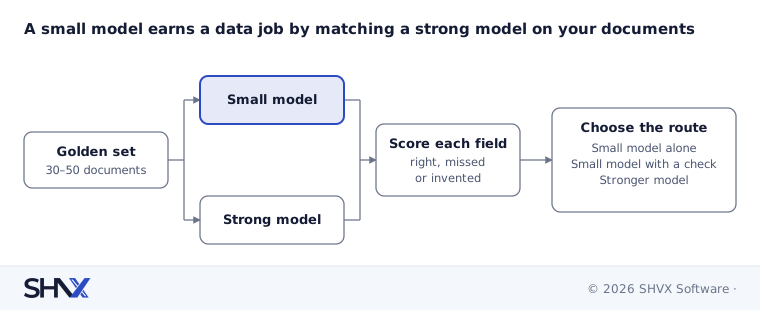
The small model gets the job only when its field-level scores hold up against the strong model on your own documents. Re-run the test whenever the model or the documents change.
Use case reference: a business AI agent on a laptop
We ran a business AI agent on an open-weight 3B small model (IBM Granite 4.2) on an everyday 16 GB laptop (see No GPU, No Cloud Bill: An AI Agent That Runs on a Laptop). It shows that a small model can do real business work on modest hardware, and the same approach carries over to sorting, structuring and extracting data from documents.
What does a fixed server cost for document processing?
A comparable cloud server on AWS costs roughly $150 to $300 a month, fixed, depending on size, region and commitment (see SLM vs LLM for Low-Volume AI Agents for the figures). It costs the same whether it processes ten thousand pages this month or a million.
Common mistakes
- Sending every page to the largest model.
- Choosing a model without a golden set.
- No confidence check, so a small model’s mistakes flow straight into the agent’s knowledge.
- Ignoring each model’s licence terms.
- Splitting documents by word count and cutting tables in half.
How SHVX can help
Getting documents agent-ready is our core work. Our Agent-Ready Data team runs a sample of your documents through small and large models and shows you field-level accuracy, how the work splits between them, and the fixed monthly cost.
Learn more about Agent-Ready Data.
FAQ
Can a small language model extract data from documents?
For narrow jobs with a fixed schema, often yes. Measure it on a golden set of your own documents.
Which small model is best for document processing?
There is no single answer; it depends on the job, your languages and your documents. We work with any open-weight small model and choose by testing two or three on your own documents.
Do small models replace large ones?
Usually not entirely. Route the bulk to a small model and the hard cases to a stronger one.
Is it cheaper than a commercial model?
At high, steady volume a fixed server often costs less, and it always costs the same each month. At tiny volumes, pay per use can be cheaper.
Server price range from public AWS price lists, November 2026.