Build vs Buy AI Agents: How Founders Should Decide
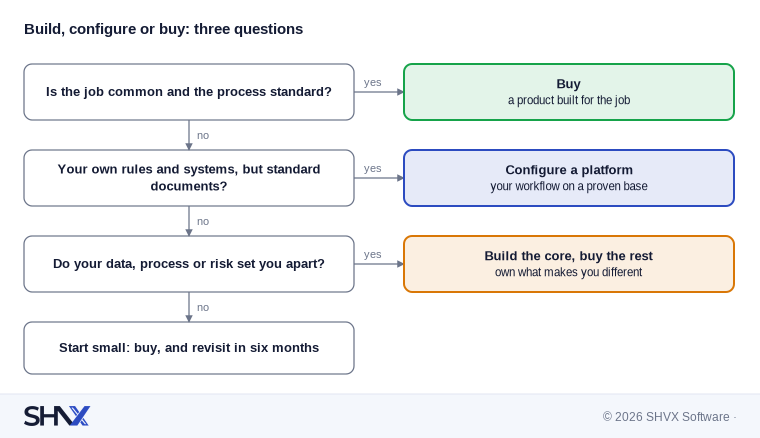
The short answer: buy when the job is common and your process is standard, such as meeting notes or a generic help desk. Configure a platform when you need your own rules but not your own engine. Build custom when your data, your process or your risk is what makes you different. Many founders land on a hybrid: buy the platform, and build the agent-ready data layer and the parts that carry their edge. Compare options on two-year cost, not setup cost.
Every founder with an AI idea hits the same question: should we buy a product, use a platform, or build our own agent? On build vs buy AI agents, vendors on every side say the answer is obvious. It isn’t, but it can be made simple. This guide is part of our Agent Engineering work, where we act as the technology team for founders who don’t have one.
What are the three options?
| Option | What it is | Best when |
|---|---|---|
| Buy | A finished AI product for one job | The job is common and your process is standard |
| Configure | An agent platform you set up with your own rules, data and tools | You need your own workflow but not a custom engine |
| Build | A custom agent built on models and your own systems | Your data, process or risk sets you apart |
The line between them is blurring. Products add configuration, platforms add code, and custom builds use platform pieces. The real question is which parts you own.
What can you buy today, and where does it stop?
Finished products are strong for common, low-risk jobs: meeting notes, writing help, general customer questions, coding assistants. They stop working well when:
- your documents are unusual: poor scans, deep hierarchies, many languages, your own forms;
- your rules are specific: approval limits, policy checks, industry regulations;
- the agent must act in several of your systems, not just answer;
- you must prove accuracy to an auditor, a regulator or your own board.
When does a custom build earn its cost?
Build when at least one of these is true:
- Your data is the hard part. Messy, specialised or multi-format documents that products read poorly.
- Your process is your edge. The way you assess, price or serve customers is why they choose you.
- The risk is high. The agent moves money, affects people’s rights or must pass an audit.
- You’ll run it at volume. Per-seat or per-action product pricing gets expensive at scale.
If none applies, buying is usually faster and cheaper.
How do you compare total cost over two years?
Setup cost is the smallest part. Compare each option over two years on:
| Cost line | Buy | Configure | Build |
|---|---|---|---|
| Setup | Low | Medium | Higher |
| Licences or seats | Grows with users | Platform fee plus usage | Usually none |
| Model and cloud usage | Bundled | Pass-through | Direct |
| Testing and monitoring | Vendor’s, limited view | Shared | Yours, full view |
| Changes and new tasks | Wait for the vendor | You configure | You build |
| Switching later | Hard | Medium | Easiest if built portably |
Our guides to AI agent running costs and how long it takes to build an AI agent give the detail behind the build column.
What about lock-in and data ownership?
Ask every vendor, in writing:
- Where is our data stored, and is it used to train anyone’s models?
- Can we export our data, prompts, configurations and test results in a usable format?
- Can we choose or change the underlying model?
- What happens to our agents if you change pricing or shut down?
If you build, avoid locking yourself in instead: keep a thin model gateway so you can switch models, and keep your golden test set so you can prove a switch is safe. Our cloud comparison covers platform choice.
Is a hybrid path better?
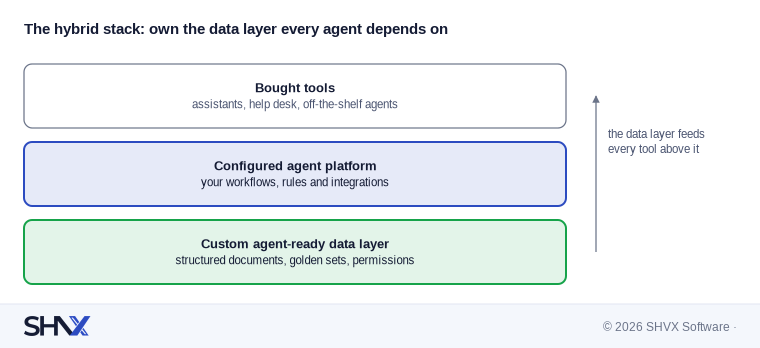
For most growing companies, yes. Buy the commodity tools. Configure a platform for workflows. Build and own the agent-ready data layer underneath: your structured documents, your golden test sets and your permission model. That layer is what makes every agent on top accurate, and it moves with you if you change vendors.
How do you choose an AI agent development company?
If you build with an AI agent development company, ask to see:
- an assessment on your own data before any big commitment;
- a pilot plan with go/no-go tests agreed upfront, as in why AI pilots fail to reach production;
- how they will test, monitor and hand over the agent;
- who owns the code, prompts and test sets at the end.
Common mistakes
- Comparing setup prices instead of two-year cost.
- Building what a cheap product already does well.
- Buying a product for work that depends on your unusual documents.
- Signing without export and data-use terms.
How SHVX can help
Weighing a vendor against a custom build? We’ll review one use case, your data and your options, and give you a written build-vs-buy recommendation with the two-year cost picture.
Learn more about Agent Engineering.
FAQ
Should I build or buy an AI agent?
Buy for common jobs with standard processes. Build where your data, process or risk sets you apart. Many companies do both.
Is it cheaper to build or buy AI agents?
Buying is usually cheaper to start. Building can cost less over two years at high volume or when product pricing grows with seats or actions.
How do I choose an AI agent development company?
Ask for an assessment on your own data, a pilot with agreed go/no-go tests, a clear testing and monitoring plan, and ownership of code, prompts and test sets.
What is a hybrid AI strategy?
Buying commodity AI tools, configuring a platform for workflows, and owning the agent-ready data layer they all depend on.