How Long Does It Take to Build an AI Agent?
The short answer: for one well-scoped agent, a realistic AI agent development timeline is roughly three to six months from first assessment to stable production, in five stages: assess, prototype, pilot, launch, then run and improve. The AI itself is rarely the slow part. Data readiness, the number of systems the agent must connect to, and risk approvals decide where in that range you land.
Ask five vendors how long an AI agent takes and you will hear “days” from some and “a year” from others. Both answers can be true: a demo on clean data takes days, while an agent that customers or staff depend on takes months. Our Agent Engineering team plans agent projects with the stages, ranges and factors below.
Four words explained
- Prototype (proof of concept): a first version that shows the core task can be done on sample data.
- Pilot: a limited trial with real users and real data, to decide whether to launch.
- Hardening: the work that makes an agent safe to run every day: security, limits, monitoring and testing.
- Gate: an agreed test a stage must pass before the next one starts.
What are the stages of building an AI agent?
Building an AI agent takes five stages: assess, prototype, pilot, launch, then run and improve, with a go/no-go gate between the first four.
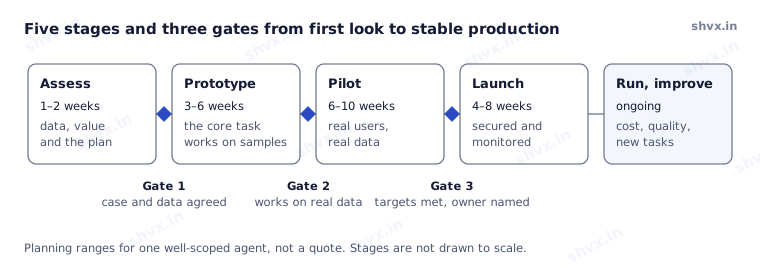
| Stage | Planning range | What you get | Gate to move on |
|---|---|---|---|
| Assess | 1–2 weeks | A scored use case, a data review and a plan | The business case and data access are agreed |
| Prototype | 3–6 weeks | The core task working on sample data, plus a first golden set | It works on real data, not just samples |
| Pilot | 6–10 weeks | Real users, real data, one live system connection, measured accuracy and cost | Targets met and an owner named |
| Launch | 4–8 weeks | Security review, limits, monitoring, on-call and rollback | Go-live sign-off |
| Run and improve | Ongoing | Monthly reviews of quality and cost, new tasks added | Each change passes the release gate |
These timelines are planning ranges for one agent doing one well-defined job, not a quote. A narrow internal agent on clean data can move faster; an agent that touches customer money across several legacy systems will take longer. Why so many projects never get past the pilot is covered in why AI agent pilots fail to reach production.
What makes an AI agent project take longer?
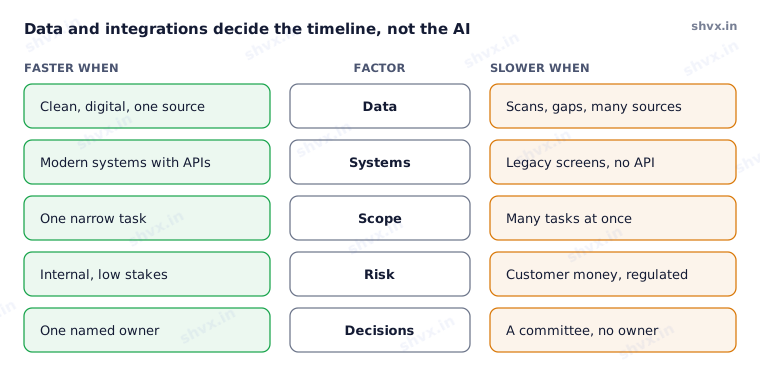
Data is usually the biggest factor in an AI agent timeline. If the documents and records the agent needs are scanned, scattered or contradictory, cleaning them comes first; see AI document extraction for large documents.
Systems come next. Modern APIs connect in days; older systems with no API need adapters and careful testing; see how to connect AI agents to legacy systems.
Scope, risk and decisions finish the picture. One narrow task with one owner moves fastest. Customer money, regulation or a committee of approvers each add weeks of review, and they should; see AI agent permissions.
How can you build an AI agent faster without cutting corners?
- Start narrow: one task, one user group, one system.
- Assess the data first, before anyone writes a prompt.
- Run the security review alongside the pilot, not after it.
- Agree the gates up front, so each stage ends with a decision, not a debate.
- Reuse what you build: the second agent on the same data and tools takes far less time than the first.
What not to cut: testing, security and monitoring. Skipping them saves weeks at launch and costs months after it; see how to test AI agents and DevOps for AI agents.
How do an AI agent’s timeline and cost relate?
Every stage of an AI agent project has a cost, and the agent keeps costing money after launch. Plan the running budget alongside the timeline; the cost of running AI agents shows how to estimate the monthly bill.
Common mistakes
- Planning from a demo built in a day.
- Starting with several processes at once.
- Leaving integration and security until the end.
- No decision date for the pilot, so it never ends.
How SHVX can help
If you need a date you can commit to, start with the facts that drive it. Our Agent Engineering team assesses your data, systems and risk, then gives you a stage-by-stage plan and builds to it.
Learn more about Agent Engineering.
FAQ
How long does it take to build an AI agent?
For one well-scoped agent, plan on roughly three to six months from assessment to stable production. Data, integrations and risk decide where you land.
Can an AI agent be built in a few weeks?
A prototype or a narrow internal tool on clean data, often yes. An agent that customers depend on, rarely.
What usually takes the longest?
Getting the data ready and connecting to existing systems, especially older ones.
How can we speed it up?
Start narrow, assess the data first, run security reviews in parallel and agree the go/no-go gates before you start.
Planning ranges reviewed by the SHVX Engineering team in November 2026.