AI Agents for Business: Use Cases in Finance, Lending, HR
The short answer: AI agents for business pay off first where work is document-heavy, rule-based and high-volume: invoice capture in finance, loan files in lending, shortlists in HR, onboarding files in insurance and regulatory updates in compliance. In each case the agent reads, checks and drafts, and a person approves. Start with the one process where your data is already in reasonable shape.
Most leaders no longer ask whether AI agents for business work. They ask where to start in their own company. This guide answers that industry by industry, and links to the detailed guide for each job. It sits in our Agent Engineering work, where we build agents that run real business processes. If you want the method for scoring your own processes, read AI in Operations first.
What makes a good first job for AI agents in business?
Across every industry, the best first jobs share four traits:
- High volume. The same task arrives dozens or hundreds of times a week.
- Clear rules. A trained person can explain how to decide, even if exceptions exist.
- Documents in, decision out. The work is mostly reading, checking and copying between systems.
- A person can review the result quickly. Mistakes are easy to spot before they cause harm.
The weak first jobs are the opposite: rare, judgement-heavy, or where one error is very expensive and hard to see.
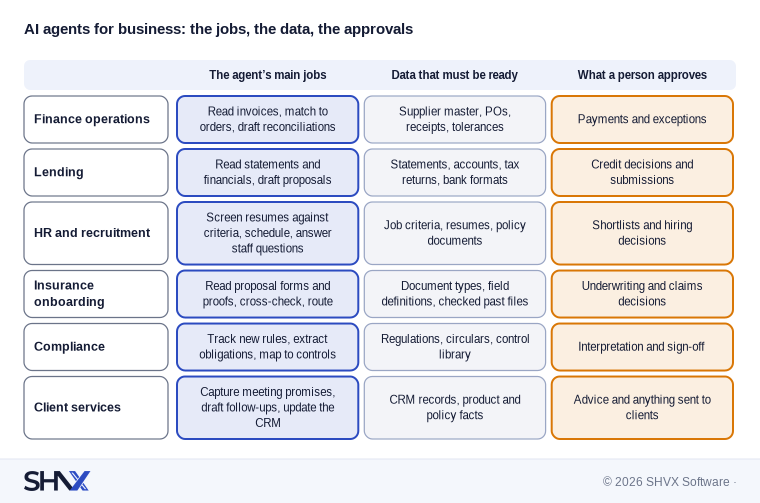
AI agents for finance operations
Top jobs: invoice capture and three-way matching, vendor and bank reconciliation, and drafting month-end accruals.
Data that must be ready: a clean supplier master, purchase orders and goods receipts recorded on time, and consistent coding history.
What a person still approves: every payment, every change to supplier bank details, and posting at month end.
For finance teams that also field data questions all week, a text-to-SQL agent answers routine questions safely. The full decision guide is Automate Invoice Processing with AI Agents. See our finance operations page for how we work with finance teams.
AI agents for lending
Top jobs: sorting the borrower’s document pile, bank statement analysis, cross-checking accounts against statements and tax returns, and drafting the loan proposal.
Data that must be ready: a document checklist per loan type, each bank’s proposal template, and agreed transaction categories.
What a person still approves: the credit judgement and every proposal sent to a bank.
See AI loan processing for the workflow and our lending page for how we work with lenders.
AI agents for HR and recruitment
Top jobs: turning job descriptions into clear skill lists, finding evidence of each skill across every resume, and drafting interview invitations.
Data that must be ready: agreed skill lists per role, a test set of resumes for bias checks, and clear rules on what candidate data you keep.
What a person still approves: every shortlist and every message to a candidate. Hiring AI faces extra legal scrutiny, covered in AI Resume Screening. More on our HR operations page.
AI agents for insurance onboarding and claims
Top jobs: reading application forms, identity proofs and claim documents, checking details agree across files, and routing unclear files to a reviewer.
Data that must be ready: a list of document types, field definitions, and a set of past files with checked answers.
What a person still approves: underwriting and claims decisions. Slow onboarding costs applications, as our KYC automation guide explains. More on our insurance page.
AI agents for compliance
Top jobs: reading new regulations and circulars, extracting each obligation, mapping it to a control and an owner, and keeping evidence.
Data that must be ready: a structured library of the rulebooks you follow, with clauses and cross-references kept intact.
What a person still approves: what an obligation means for your business, and every control change. The scale is real: Thomson Reuters figures, cited by Regnology, put it at more than 55,000 regulatory alerts from about 1,000 regulators in 2019 alone. See our compliance page.
AI agents for client services
Top jobs: answering routine questions from your own documents with citations, tracking follow-ups from client meetings, and preparing case summaries for advisors.
Data that must be ready: current, approved knowledge sources and clear hand-off rules. See AI notes for in-person meetings and how to prevent hallucinations.
How do you choose where to start with AI agents for business?
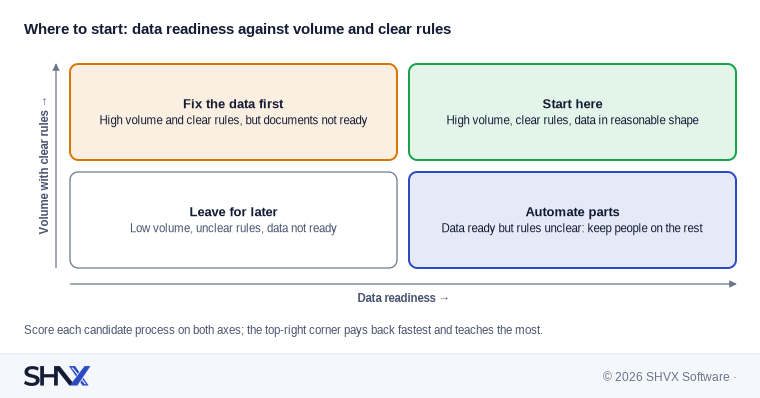
- List five processes that take the most hours each week.
- Score each one on volume, clarity of rules and how ready its data is.
- Pick the top-right one and run it on past cases before going live.
- Plan the next two that reuse the same data, so each new agent is faster to add.
For a realistic plan, see how long it takes to build an AI agent.
Common mistakes
- Starting with the most exciting process instead of the one with the best data.
- Choosing a use case nobody owns.
- Measuring a demo instead of past real cases.
- Letting the agent approve or pay on its own.
How SHVX can help
Not sure where AI agents fit in your business? Tell us your industry and the process that eats the most hours. We’ll estimate what an agent could save and what data it needs first.
Learn more about Agent Engineering.
FAQ
What are the best AI agent use cases for business?
Document-heavy, rule-based, high-volume work: invoice capture, loan file preparation, resume screening, onboarding checks and regulatory change tracking.
Which industries benefit most from AI agents?
Those that run on documents and rules: financial services, lending, insurance, healthcare administration, HR and compliance.
How do I find the right first process for an AI agent in my company?
Score your busiest processes on volume, clarity of rules and data readiness, and start with the one that scores highest on all three.
Do AI agents replace staff?
In these use cases they remove reading and retyping. People keep the approvals and the exceptions.